
You’re reading this on the internet, so there’s about a zero percent chance you haven’t heard of Netflix’s latest streaming phenomenon: Bird Box. It’s the film everyone’s been talking about lately, despite the fact that no one seems to be actually talking about it. We’ve seen the Bird Box Challenge videos, where people blindfold themselves and fall down go boom, and there’s even a restaurant in Atlanta that offers a Bird Box-themed dining experience, but not much seems to have been made of the film itself.
But in a way, that all makes perfect sense. Bird Box is exactly the kind of film that would become a hit on Netflix and spawn a viral video craze. It’s a high-concept, low-commitment film that doesn’t ask us to get too emotionally attached to anyone who’s not Sandra Bullock. And even then, Bullock is working overtime to make sure we hate her everloving guts. It’s also written in such a way that it never demands your attention for more than ten minutes at a time, and devoting your full, undivided attention to it for two hours and four minutes is not significantly more rewarding.
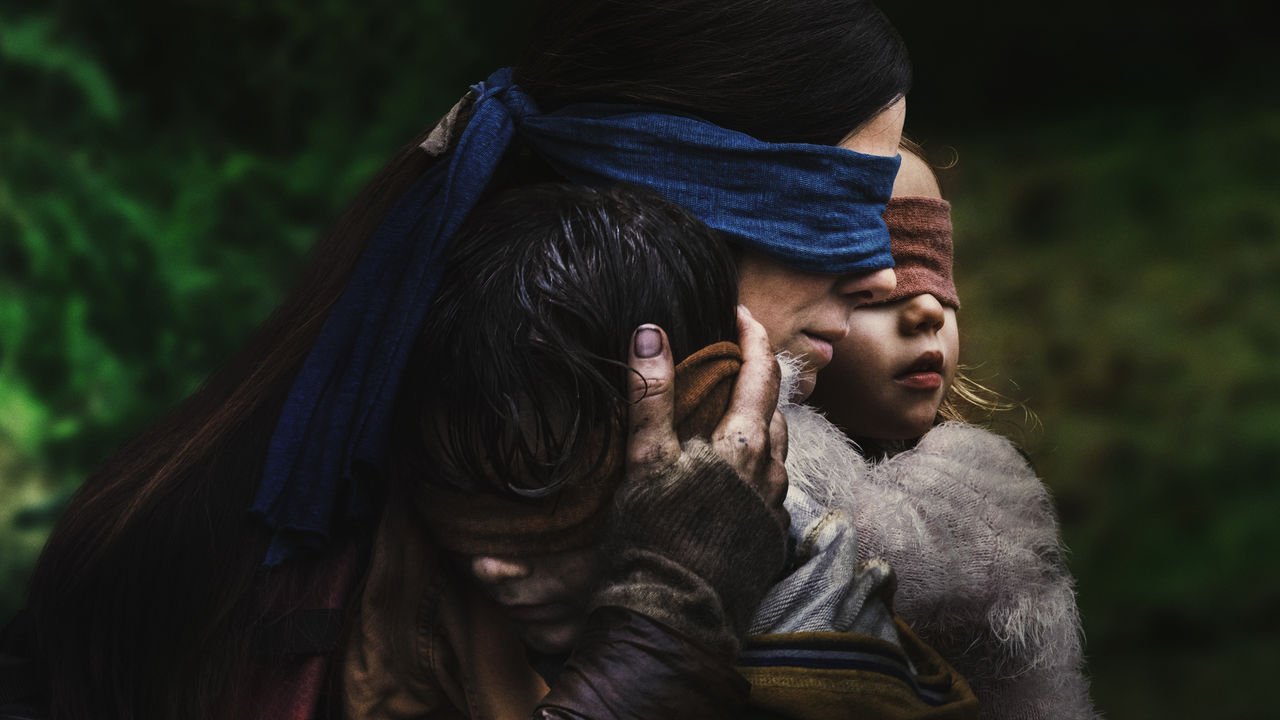
Jumping back and forth between two timelines—during the beginning and immediate aftermath of an ill-defined apocalypse, and also five years later—Bird Box puts us in the shoes of Malorie (Bullock), an emotionally distant artist who is pregnant with a child she doesn’t want. The film opens five years later, as Malorie impresses upon her young wards the danger that lies ahead. They’re preparing to travel downriver to a possible sanctuary, all while blindfolded. We then cut back to the beginning, as a global pandemic strikes the West Coast. Malorie seeks shelter in a nearby house, where we meet other survivors such as John Malkovich, Trevante Rhodes, Rel Howery, BD Wong, Jacki Weaver, and plenty of others who probably won’t make it out alive. It’s a surprisingly stacked cast of recognizable faces, one of many times this film reminded me of Frank Darabont’s The Mist.
The easiest way to describe the event is to just call it what it is: Invisible space vampires that make you kill yourself. I say ‘invisible’, because the threat is personified as swirls of CGI leaves. I say ‘vampires’, because their primary tactic is to entice people to open doors, take off their blindfolds, anything to get them to look and infect them with whatever crazy makes them kill themselves. And I say ‘space’, because honestly, where else would this have come from? Howery mentions a religious reckoning where demons take over the Earth, but is immediately dismissed as a crackpot who internets too much, and the idea is never brought up again. So invisible space vampires.
The film is at its best when we’re cooped up in the house, where the cast bickers among themselves, sort out survival plans, make the odd excursion outside, and so on. Like I said, there are shades of The Mist here, and when the film asks its characters to bounce their ideologies off one another, it’s pretty good. Malkovich spends most of his screen time telling everyone else to shut the hell up, which gets tiresome, but for the most part it’s a well-assembled cast.
Unfortunately, this really isn’t what the film wants us to focus on. It’s more interested in the survivalist subplot, where Malorie has to take two kids downriver blindfolded. The rest of the cast is conspicuously absent, and considering how quickly the film shows us this (hell, it’s where the film starts), it’s not really a spoiler to say that none of these people survived the ordeal. You can’t really accuse Bird Box of spoiling these deaths so early when they’re all dead when the movie starts anyway. That’s obviously not the game the film is playing here. The real questions to ask, which is to say the dramatic questions, are who, and how, and in what order. And even then, that doesn’t necessarily matter.
____________________________________________________________________________________________
So it’s here that I’m going to issue a **spoiler alert** for the next part of this discussion, because this next part is clearly what director Susanne Bier finds more compelling.
____________________________________________________________________________________________
It’s been established that Malorie wants nothing to do with her baby. Just before the pandemic strikes, she is very close to considering giving it up for adoption. And then all through the ordeal, she insists people not treat her like she’s pregnant, and generally acts like it’s not even there. Out of sight, out of mind. Later, another pregnant woman enters the house. She is Malorie’s polar opposite. She can’t wait to have her baby, is terrified of this pandemic, and begs Malorie to take care of her child if anything should happen to her.
The river sequence, then, finds Malorie burdened with two small children she doesn’t actually want; one that is hers, and one that isn’t. The rapids are fast approaching, and the only way to survive them is for someone to be the lookout and give directions. This, of course, is a death sentence when there are invisible space vampires around, and so Malorie has to make a decision. One of these children has to be the lookout while Malorie rows. Will she choose her own son, who she never wanted in the first place? Or will she choose the daughter foisted upon her by chance? It’s the moral quandary the entire story has been building towards, asking us how coldhearted and calculated can we possibly be when survival is at stake. But instead of acting in accordance with her own survival-at-all-costs mentality, Malorie finds another way.
I’m inclined to read this as a rebuttal to the utter nihilism of so many apocalyptic survival stories. How many times have we seen characters on The Walking Dead decide who lives and who dies on nothing but a split-second whim? This all keeps bringing me back to The Mist. Sacrificing a loved one for the greater good, or for their own good, or for any reason for that matter, feels like such a cliched beat at this point, that it’s honestly kind of refreshing to see a film resort to something other than murder for once. Whereas The Mist immediately punishes its characters for assuming there’s no other way out, Bird Box suddenly finds hope where there otherwise is none.
Of course, Malorie’s change of heart happens in an instant, with very little foreshadowing, but I’ll take small favors wherever I can get them. While it’s not necessarily a cop out, it does feel like a dramatic swerve from which the film never recovers. Bird Box doesn’t quite earn Malorie’s redemption, just like it doesn’t quite pull off a lot of the things that it tries, but it’s a weirdly ambitious effort all the same.
In the end, it’s not a movie about invisible space vampires at all. It’s a movie about motherhood. Put that on the poster and I guarantee you 45 million people would not have watched it. A YouTube craze where blindfolded moms pour hot coffee on their shoes? Now that’ll sell just about anything.

Leave a comment