

Steven Spielberg’s Jaws taps directly into our innate desire to conquer our domain. It’s a classic story, but also one that could only have been told at that specific point in American history. 1975 was the middle of the Cold War. We had just gotten out of Vietnam, the Greatest Generation was entering middle-age, and events like the Watergate scandal and the 1973 oil crisis were slowly starting turn American culture sour. Perhaps that’s why Jaws has all the warmth and coziness of a Norman Rockwell piece; Spielberg wanted to ease us into this primal tale of horror and domination by painting a picture of America as idyllic and pure. (Imagine I put a million scare quotes around those last words.)
Jaws is a story of American men fleeing the problems of civilized society in search of something simpler. Martin Brody (Roy Scheider) leaves his job with the NYPD for what he assumes will be the simple life as the police chief on Amity Island. There hasn’t been a murder here in nearly twenty years, he says, while in the Big Apple parents have to walk their kids to school for fear of losing them to God only knows what. This was the dangerous, grimy New York City captured in films like The Taking of Pelham One Two Three and Taxi Driver (which came out a year later, but same difference). Brody rejects that life for a quieter one in a town whose biggest problem is karate students chopping off the tops of picket fences. His fear and disdain for the troubles of the city outweigh his deep-seated aversion to water. “It’s only an island if you look at it from the water,” he says. Tell that to Manhattan. Brody’s hopes for a quieter life are dashed the moment a dead body washes ashore with huge pieces missing.
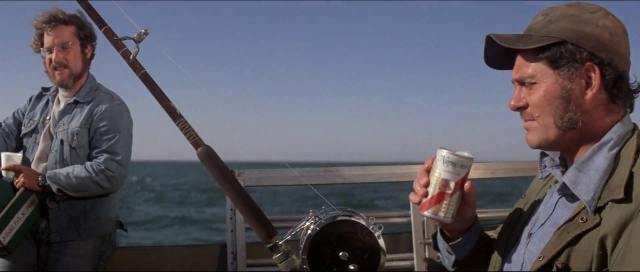
Richard Dreyfus plays Hooper, an oceanographer who’s fascinated by sharks, and has lots of gadgets and equipment for observing them. He’s the rich kid who gets to travel the world and play scientist with the family fortune, which also means he’s the comic relief that gets kicked around anytime the real men start talking. You can bet if this film had taken place on the Gulf of Mexico, you’d have all kinds of southern bumpkin caricatures calling Hooper “college boy” and crap like that. Hooper knows what he’s doing, though, and the anti-intellectual brigade isn’t gonna slow him down. Quint, however, has no quarrel with Hooper’s brain. Just his money. He blasts Hooper for having soft hands, having never worked a day in his life. He’s not wrong.
Quint, played by Pelham‘s Robert Shaw, is Amity’s resident grizzled old fisherman. The way Shaw plays him, Quint doesn’t have time for anyone’s horseshit, and he’s earned that right. He’s brash, crude and cuts straight to the point. He asks for $10,000 to hunt and kill the shark, but you get the sense that it’s never really about the money. He’s out for himself.
Because Quint, like Brody and Hooper, has demons to contend with. There’s a fear bubbling underneath Quint’s gruff exterior. For as often as he wistfully sings sea shanties and stares off into the horizon, Quint has seen horrors that most folks will never know. His story about the sinking of the USS Indianapolis is harrowing, and by the time his telling is over, you can see the resignation on his face. He knows either he’ll be the death of that shark, or it’ll be the death of him.
The Indianapolis, as he tells it, delivered “the Hiroshima bomb.” In truth, the crew delivered the components for the bomb known as Little Boy to the island of Tinian, where it was assembled and then flown out on the Enola Gay. The Indianapolis was subsequently torpedoed by a Japanese sub where, due to the secrecy of the mission, distress signals were ignored for three days before a rescue was launched. Quint tells of survivors banding together to ward off shark attacks, sometimes successfully and other times not. After that experience, he declares, he’ll never put on a life jacket again. True to his word, as the Orca begins to sink, Quint throws Brody a life jacket but declines it himself.
It’s hard to look at Quint and not see a man running from his own past. He’s dedicated his life to conquering the monsters of the deep, in part to quell his own fears, but also because after watching your comrades fall prey to a shark, there’s just no going back. Having done what Quint has done, and seen the things he’s seen, there’s no place in the civilized world for him.
As the shark makes its final attack on Quint’s vessel, the power goes out, to which Hooper exclaims, “He ate the light!”
At this point, the shark is no longer simply a shark. It’s a cosmic reckoning. In his own small way, Quint helped to unleash the power of the atom on the world. In return, the shark is going to consume everything in Quint’s world, up to and including the light itself. The shark’s gaping maw is a black hole from which nothing can escape. Not even Quint.
Hooper is able to gaze into the abyss and survive, thanks to his observation cage and scuba gear. He’s the only one willing to enter the shark’s domain on its terms. It’s his respect for science, and the sea at large, that saves his life. Also the money. Okay mostly the money.
For Brody’s part, his is a combination of tenacity and dumb luck. Brody looks into the mouth of that shark and sees the inky black void. Just like with Quint and the Indianapolis, Brody’s encounter with the shark puts a mark on him that he’ll never quite shake. Fast forward to Jaws 21 and we find Brody strung out and paranoid over the coming holiday weekend. When more people start washing up dead, we see Brody capping his bullets with cyanide to prepare for the next inevitable shark encounter. Instead, Brody is so gung ho about shooting a shark in the face that he nearly murders a kid right in front of the entire town. That’s the kind of thing that’ll turn people on their police chief. Brody only redeems himself by stealing a police boat to rescue a bunch of kids, and then tricking a shark into chomping on an electrical cable. He’s looked into the abyss once; the second time it’s nothing.
The only person able to fully escape the grisly fate of the Orca turns out to be Hooper, and that’s only because he’s got the connections to get away from Amity as fast as humanly possible. Turns out the only thing that can escape a black hole is lots and lots of money.
- The movie’s French title, Les Dents de la Mer, literally translates to “The Teeth of the Sea”. The joke surrounding Jaws 2 was that the French title for that film (Les Dents de la Mer Deux) sounded like “Les Dents de la merde”, or “The Teeth of the Shit” which, given Brody’s mental state after the events of the first film, is strangely apropos. ↩︎

Leave a comment