
Originally published October 3, 2015 on FrontRowCentral.com
It’s taken a couple films to bring me around on Denis Villeneuve, but Sicario has me finally convinced this guy is the real deal. While his English-language debut, Prisoners, felt like a film trapped in an endless spiral of torture and despair, Sicario manages to strike a much more palatable tone while still dealing with disturbing subject matter. In highlighting the the drug war and illegal immigration as two sides of the same political coin, Villeneuve has crafted a film that’s equally effective as a meditation on moral relativity as it is a pure-strain white-knuckle thriller.
After overseeing a hostage situation that comes to a particularly gruesome end, FBI agent Kate Macer (Emily Blunt) is recruited by a shady CIA man named Graver (Josh Brolin) to aide in clandestine operations across the Mexican border. The team’s goal is to wreak havoc among the competing drug cartels until somebody cracks, but soon Kate discovers that Graver’s partner Alejandro (Benicio del Toro) has ulterior motives. As Kate learns more and more about the true nature of their operation, she’s forced to question the ethics of the job, as well as her role in the greater law enforcement machine.
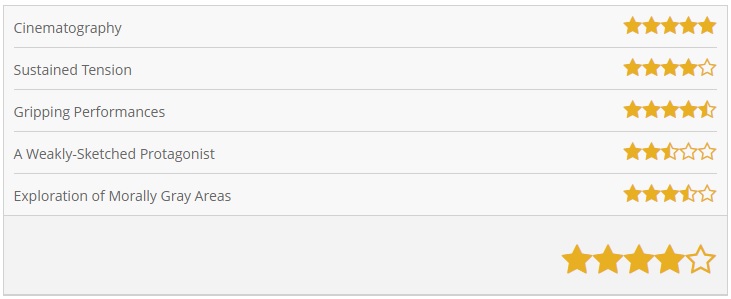
Right from the start, Sicario is loaded with a number of details to unpack. The film opens by explaining the origin of the word ‘sicario’, which we learn is a Spanish term for ‘hitman’. Hitmen and contract killers play a significant role in the film, but the lion’s share of the story follows Kate as she wades deeper and deeper into this world of unorthodox policing. Kate’s role in the story is a tricky one, actually. As written, she’s little more than a cipher, someone for Brolin and del Toro to explain the plot to while going about acting like they own the movie (and they more or less do). Kate exhibits only brief moments of agency, and if there’s any downside to the film at all, it’s that Blunt isn’t given nearly enough material to work with. It’s still a killer performance, but she’s essentially squeezing blood from a stone.
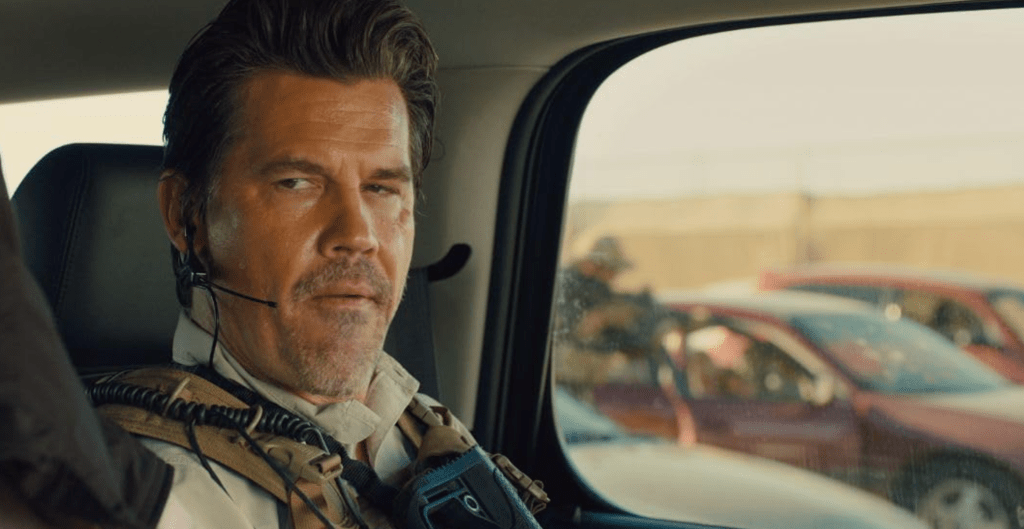
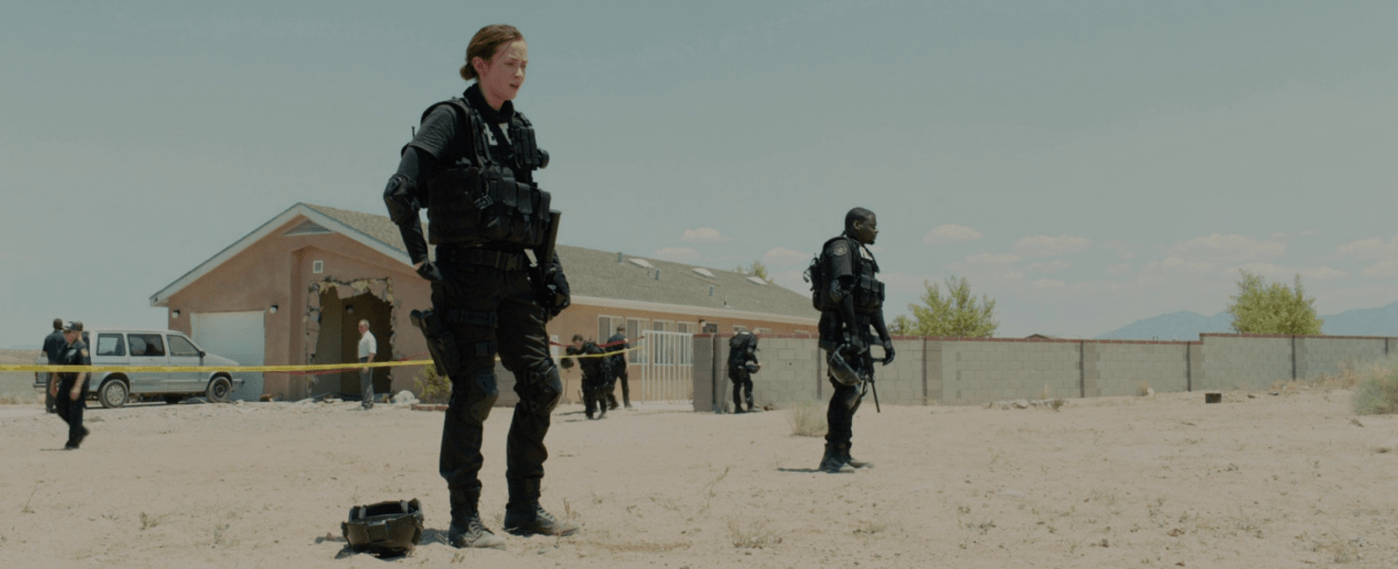
It would be easier to complain about Sicario downplaying Blunt’s role if the rest of the film weren’t so damn enthralling. The film is structured as a series of stacked operations, each eventually leading into the next. The standoff that opens the film is quick and brutal, setting an uneasy tone for the rest of the film, but it’s only the tip of the iceberg. Kate quickly joins Graver, Alejandro and a handful of Blackwater-esque mercenaries on a mission to retrieve a drug cartel stooge for questioning. This second mission is a much more protracted affair, and the way Villeneuve builds the tension in this scene is nothing short of remarkable.
As they cross the border on their first mission together, Graver tells Kate to keep an eye out for shooters. Suddenly, every passerby looks like a potential enemy. Jóhann Jóhannsson’s monotone score slowly builds as the SUV convoy snakes its way through the city. In helicopter shots, the convoy sticks out like a sore thumb; there’s no way this mission isn’t going to end in a hail of gunfire. When a gunfight finally breaks out, it’s treated with clinical precision. The end result is sickening, bodies strewn all over a busy highway. Villeneuve’s message is clear: This is only the beginning; imagine how much worse it could get. Naturally, it gets worse. Each operation gets more tense and claustrophobic than the last, culminating in an underground shootout in a tunnel beneath the US/Mexico border.

But for as disturbing and politically-charged as this film often is, it’s impressive that Sicario never outright puts its politics on display. In another director’s hands, one could imagine a more broadly xenophobic version of this film, a film more suspicious of Mexican immigrants. It’s to screenwriter Taylor Sheriden’s credit that the film depicts these people exactly as they are: innocent pawns trapped in a political chess match. As it turns out, there are enemies and allies on both sides of the fence, because the CIA isn’t the only one playing this game. The film introduces a Mexican police officer (Maximiliano Hernandez) as a foil for Kate, illustrating that this film could easily take place from the opposite perspective. His journey isn’t fleshed out as well as Kate’s, but it offers yet another lesson in how well-meaning people are used in the service of darker ends.
Minor quibbles aside, Sicario offers one of the year’s most thematically rich moviegoing experiences. Coupled with excellent performances and some truly beautiful camerawork from Roger Deakins (Please, give this man an Oscar already!), Sicario is an exercise in sustained tension that rivals anything you’re likely to find in theaters this season. If crime thrillers are more your speed than all the frights and scares of Halloween, this is your ticket right here.

Leave a comment