
“There’s a city in my mind
– Talking Heads, “Road To Nowhere”
Come along and take that ride
…
Would you like to come along
You can help me sing the song”
With the sudden passing of Paul Reubens last year I, like many of my generation, have been revisiting his work as the inimitable Pee-Wee Herman. The living cartoon character, who in his 1981 stage show declared himself “the luckiest boy in the world,” was an inspiration to every weird kid who ever grew up into a weird adult.
He taught us that growing up didn’t mean having to put away your childish things for good. It was okay to indulge your inner child from time to time, and many of us did through “Pee-Wee’s Playhouse”. Every Saturday morning, we got thirty minutes of concentrated playtime, screaming at the secret word, and a lesson in meeting people where they are. Everyone’s weird in their own way, and that’s just fine. We can all be weird together.
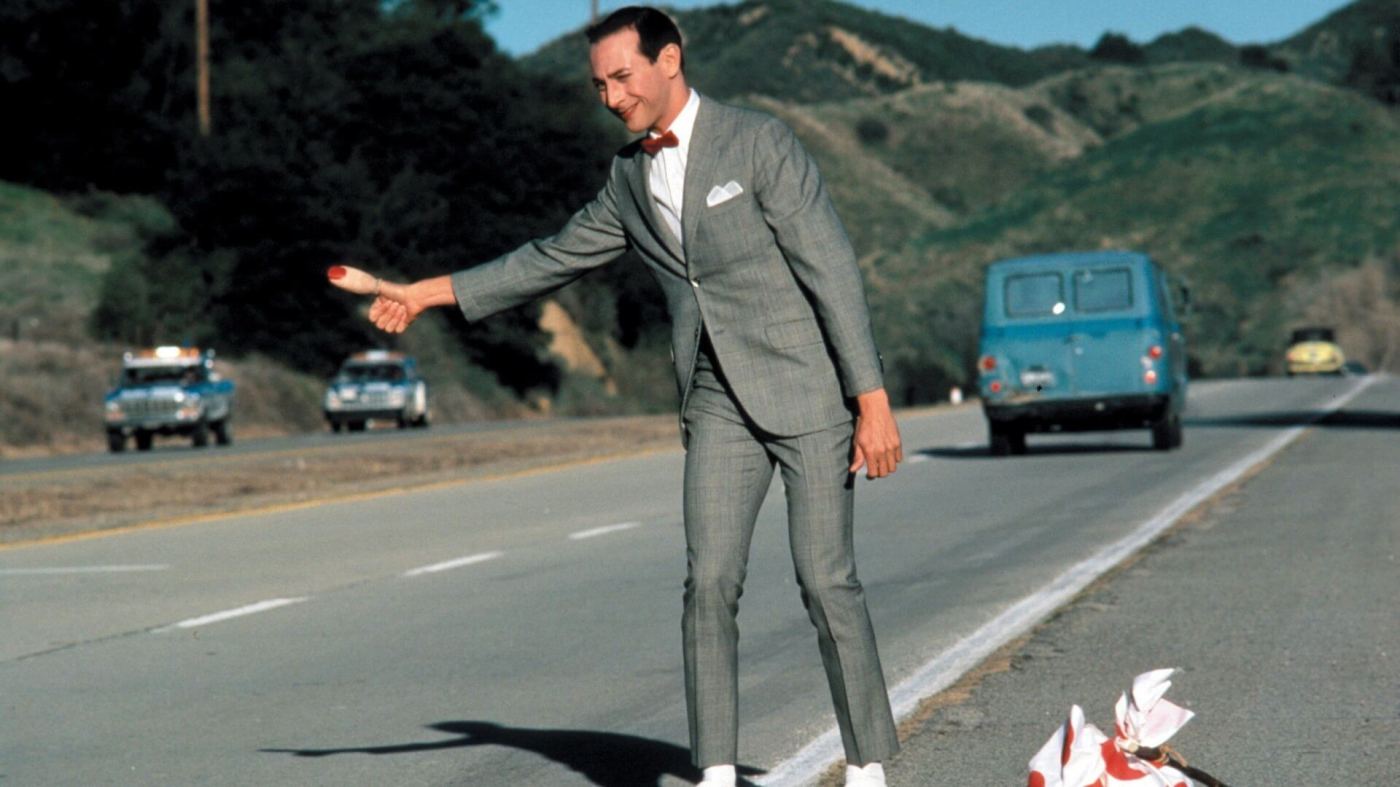
But while revisiting his first feature film, 1985’s Pee-Wee’s Big Adventure, I realized that the reason this movie has endured over the decades is that it’s kind of the perfect road trip movie. Pee-Wee’s quest to recover his stolen bike takes him across America, making an iconic pit stop at the Alamo and landing in Hollywood, California. Along the way he meets a cast of oddballs and misfits who all in their own way find his childlike attitude charming.
Then when you really look at the film closer, every stop on Pee-Wee’s trip all kinda looks the same. All the terrain and locales look suspiciously like Southern California. In fact, aside from the one scene of Pee-Wee arriving at the actual Alamo, the entire film was shot in and around Los Angeles, CA. You could look at this as just a function of a relatively low budget ($7 million will only get you so far). But it can also be read as a stylistic choice. There’s a kind of homogeneity to the sights of Pee-Wee’s Big Adventure, almost as though Reubens and Tim Burton are saying all of America basically looks the same; it’s the people that make it unique.
Now when you think of the classic American road trip, it conjures images of Route 66 and long stretches of highway through scenic desert vistas, with nothing to keep you company but billboards advertising roadside attractions and gas stations lit up in all their neon splendor. Pee-Wee Herman lives and breathes this kind of kitschy Americana, so it only makes sense that his Big Adventure would find him hanging out at the Cabazon Dinosaurs. And if there’s any sameness to it at all, it’s because many of the small towns you drive through on your way from here to there really do look alike. In the 80s, that lingering 50s design aesthetic kind of makes it all bleed together.
My only real complaint with Pee-Wee’s Big Adventure is that it isn’t “big” enough. I wish he’d visited more weird roadside oddities and encountered even stranger people. Or failing that, I wish we’d gotten more ‘big’ adventures where Pee-Wee meets all sorts of weird people from all over the country. But the good news is that Pee-Wee wasn’t the only one in the 80s treating us to the sights and sounds of the desert.
In 1986, Talking Heads frontman David Byrne brought us a film every bit as enamored with the kitsch and mundane beauty of everytown America. True Stories features Byrne as our narrator as he travels to the remote town of Virgil, Texas to take part in the town’s 150th anniversary celebration. As we tour the town and visit with its people, we come to love it for its sleepy “special-ness”.
John Goodman is there as a panda bear-shaped bachelor; Pee-Wee Herman Show co-star Tito Larriva appears as a man who claims his head can pick up radio waves; Swoosie Kurtz is a woman so rich she’s never had to get out of bed. We sit in on an evening of karaoke (set to the music of Talking Heads, naturally), witness a truly odd shopping mall fashion show, and finally join in the town’s revelry at the big talent show. Don’t tell me Pee-Wee Herman wouldn’t have fit right in here.
Strewn throughout the film are quiet moments where we get to watch the town simply exist. The soft tones of a slide guitar play out over the stillness of a gas station at dusk. Gangs of children snake their way through front yards and vacant lots on their way to who knows what kind of mischief. As the closing credits roll, Byrne’s voice rings out while a little girl skips and dances down the road away from the camera. We may be leaving Virgil, Texas behind, but that little girl keeps going, her life continuing down its own path.
In the same way, all of us follow our own path, regardless of where the rest of the world goes. That’s called life. One of Talking Heads’ most famous songs is all about it. “Road To Nowhere” is in once sense fatalistic and depressing; we’re all going to die someday, and there’s nothing any of us can do about that. But in another sense, knowing that is kind of liberating. When you realize your days are numbered, even if you don’t know the exact number, you also realize there’s nothing left to do but to enjoy your time while you still have it.
Visit someplace new, see the sights, meet the weird people of the world. Hell, BE the weird people of the world. Make the world want to meet you. Be yourself and have an absolute ball doing it, because in the end that’s all there is. We’re all on that Road to Nowhere, so why not make it one big adventure?

Leave a comment