
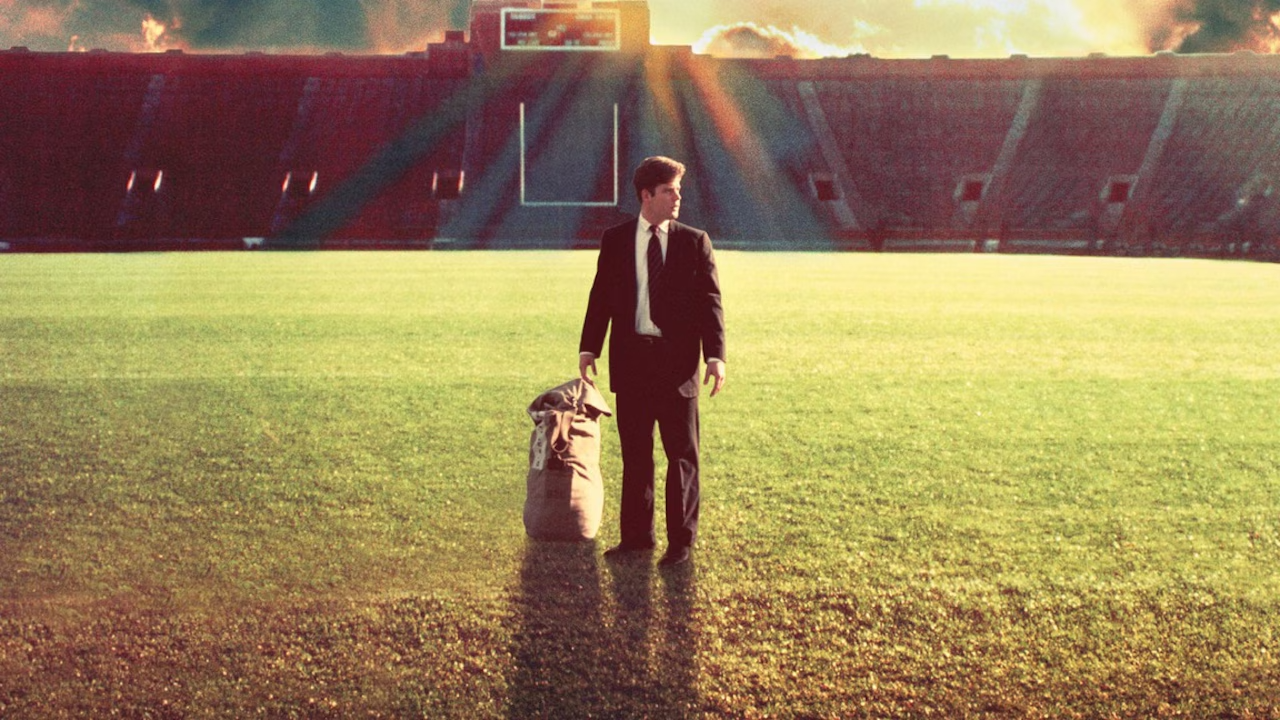
In Twenty 20-Fav, we’re spending 2025 examining the work of actor/director Jon Favreau. Our journey begins with a look at Rudy, a scrappy little underdog of a sports drama.
Have you ever just wanted something? Have you ever had an ambition in life that only seems to matter to you. I certainly know what that feels like. I’m doing it right now, writing this piece on a movie from thirty-two years ago in the hope that someone, somewhere might enjoy reading it. Is that a silly dream? Is it a waste of time? Maybe. But it’s the only thing I’ve ever wanted to do, and I’ll be damned if I don’t enjoy doing it.
Rudy is all about this. Even though I’m only vaguely familiar with Notre Dame, or football in general for that matter, I can still relate to the story of a little guy with no talent who still chases his dream just because it’s the thing he wants to do. The film comes from director David Anspaugh and writer Angelo Pizzo, the team responsible for Hoosiers, another inspirational tale about Indiana sports history. In fact, it was that very film that inspired Dan “Rudy” Ruettiger to try and give his life story the silver screen treatment. Ruettiger played defense for the Notre Dame Fighting Irish for roughly thirty seconds in 1975, which in and of itself is not particularly inspiring1. This, however, is a case where the journey matters far more than the destination.
Growing up in Joliet, Illinois, Notre Dame football was in Rudy Ruettiger’s blood. As a kid he’d play a record of coach Knute Rockne’s famous locker room speech2 and reenact it for his brothers. The family would eat dinners in the living room as dad (Ned Beatty) insisted on watching the Notre Dame game on TV. Rudy’s one and only dream in life was to play football for Notre Dame, despite being the runt of the family with no discernible knack for football. One wonders if Rudy’s single-minded obsession of playing for Notre Dame stemmed from a belief that that’s the only way dad would ever actually notice him.
Fresh out of high school, a now-grown Rudy (Sean Astin) works at the steel mill with his best friend Pete. Pete, the only person who actually believed in Rudy’s dreams, dies in an accident at the mill, causing Rudy to take stock of his life and realize he’s not getting any younger. Buying a house and moving in with girlfriend Lili Taylor is gonna have to wait. (Though, predictably, she doesn’t.) After Pete’s funeral, Rudy’s on a bus to South Bend, Indiana and meets with local priest Father Cavanaugh (Robert Prosky), who helps him apply to Holy Cross Junior College with the hope of getting good enough grades to transfer to neighboring Notre Dame. Only then can he try out for the actual football team.
The deck is stacked against Rudy from the start. He’s scrawny, he’s dyslexic, he’s not even officially a student. He’s at the bottom rung of a very tall ladder, and the middle act of the film becomes a series of transactions and montages of Rudy working his way up. To get close to the team, he volunteers to work for Fortune (Charles Dutton), the head groundskeeper of Notre Dame Stadium. To get his name in the mix, he badgers Coach Parseghian (Jason Miller) about someday joining the team. And to get his grades up he enlists the help of his class TA, a big burly goofus named D-Bob (Jon Favreau), who agrees to tutor Rudy if he’ll help D-Bob meet girls. At times it feels nakedly instructional, like it’s trying to illustrate to kids how the real world is supposed to work. (Ruettiger would go on to become a motivational speaker, so I’m sure this was entirely by design.)

But incrementally, Rudy’s hard work starts to pay off. He finally gets to transfer to Notre Dame in his junior year, which gives him the chance to try out for the team. Despite having no actual ability on the field, Rudy fights tooth and nail through each practice, landing a spot on the practice team, where he proceeds to make a fool of Quarterback Jamie O’Hara (some jerk named Vince Vaughn) in front of Coach Parseghian. Rudy even meets his polar opposite, a legacy student named Jim (Mitch Rouse), who miserably toils away on the practice team so that his old money family will keep paying his tuition. Jim isn’t here because he wants to be, but because tradition expects it of him. For Jim, playing football isn’t a dream, but a curse. None of this computes with Rudy, who spends his nights sleeping on a cot in the stadium supply closet because he wants to be there that badly.
Rudy seems to finally get ahead as Parseghian promises Rudy a spot on the bench in his senior year. Then the coach turns around and retires, paving the way for new coach Dan Devine (Chelcie Ross), who has no intention of honoring such a promise. It’s only after the entire team offers to let Rudy take their place on the bench, in a scene where one by one they enter Devine’s office and lay down their jerseys, that Devine acquiesces and agrees to let him even suit up.
This little twist is apparently a work of fiction, as the real life Dan Devine was fond of Ruettiger, and claimed he had every intention of letting him play. According to IMDb, the world’s leading expert on sports trivia, Devine graciously allowed the production to turn him into a heel if it would help get the movie made. Then he saw the finished film and balked at the jersey scene all together. You’d think if even one player offered to lay down their jersey for Rudy, Devine would just say “Okay, sure,” and that would be that. But that is not a dramatic moment, now is it?
It’s a nice little heartwarming scene; certainly one of the film’s highlights. It illustrates how far Rudy’s come with the team and how much they’ve all begun to root for him. He’s become the team’s little brother and they’re all just trying to look out for him. When the AFI placed Rudy on its “100 Years, 100 Cheers” list, the jersey scene was what probably clenched it. It may not have played in South Bend with Dan Devine, but it sure as hell plays in Peoria.
So yeah, of course, it’s inspiring to see Rudy’s years of hard work finally come to fruition. Rudy invites his family down to see him play in the final game of the season. D-Bob makes his triumphant return from law school. Even Fortune makes an appearance3, honoring his promise to at least watch the game if Rudy made it onto the bench. I think that’s the part that always tugs at my heartstrings: It’s not so much that Rudy finally achieves his goal, it’s that his friends and family cheer him on, chanting his name as they watch him do it. He’s no longer proving wrong the people who got in his way; he’s celebrating his dream with the people who believed in him (even if his dad and brother really didn’t, but whatever).
My favorite part of the movie is kind of the unspoken joke of the entire story, which is that once Rudy finally gets to play, he has no idea where to go. He runs out onto the field with the defensive line, and in a fit of confusion he turns to the coach and shouts “What do I do!?” To see a guy grow up playing football, obsessing over football, practicing on teams for years, and then suddenly realize he doesn’t know how to play the game… I dunno. Something about that strikes me as funny. For all his drive and hunger to play football, at no point did he ever seem to learn the game. It hits on an essential truth about life: Sometimes the folks who care the most about their job are the ones least suited to doing it, while the ones best suited for the job don’t even care. Honestly, most people get to where they are in life without actually knowing what they’re doing. (It’s a feature of our society, not a bug.)

Sean Astin is genuinely great in this movie. He has such an easy charisma about him that makes Rudy seem lovable. Who wouldn’t want this kid to succeed? He’s such a gentle, earnest soul that it makes the scenes where he’s struggling seem all the more heartbreaking. He’s just trying so damn hard and seemingly getting nowhere for his trouble. Now that I think about it, that also perfectly describes little Mikey in The Goonies and Sam in Lord of the Rings. And while those might be more iconic roles, no matter what else I see him in, Astin will always be Rudy to me.
But the real star of this film isn’t Sean Astin or Jon Favreau or even Notre Dame. It’s Jerry Goldsmith4. The score for this film, like many of his others, is brassy and inspirational. It serves to heighten Rudy’s journey, especially during the training montages where he’s practicing with the football team and taking hit after hit after hit. That piece of music, fittingly titled “Tryouts” is the standout, and has since been featured in a dozen movie trailers and commercials to underscore triumph over adversity and all that fun stuff. It vaguely echoes Aaron Copland’s “Fanfare for the Common Man”, which incidentally would also be the perfect title for this piece.
Goldsmith’s score takes what was already a mildly inspirational story and elevates it to the level of heroic mythmaking. The score may have outlived Rudy, in terms of cultural relevance, but Rudy is a perfectly solid sports story in its own right. The movie only barely turned a profit at the box office, but quickly became a basic cable staple. It’s not quite in the upper echelon of sports movies, but it’s definitely earned its place on the JV team. I got no problem with Rudy.
THE FAVREAU DIMENSION
Rudy wasn’t Jon Favreau’s first feature, but at this point in his career it was easily his biggest role. And D-Bob is one of the highlights of the movie. Favreau immediately comes across as a likable, larger-than-life figure in it. He’s built like a football player5, much moreso than Rudy, but D-Bob is a lover, not a fighter. He walks around the Catholic school campus constantly taking the lord’s name in vain, but he’s also intensely shy when it comes to girls. D-Bob is kind of a hilarious contradiction, and Favreau is clearly having fun with the role. This marks the start of Favreau’s long, illustrious career as a reliable character actor and, as we’ll see moving forward, there’s freedom in staying out of the limelight.
The other important thing to note here is that Rudy is also the feature debut of Vince Vaughn. As he appears in the film, the Vince Vaughn persona already seems fully formed. Arrogant, kinda snarky, and already acting like the world owes him a favor. Favreau and Vaughn first met on the set of this film, and we’ll talk plenty more about the pair in the future, so let’s not dwell on that here.
FINAL RATING
3.5 stars (out of 5). S’pretty good.
NEXT TIME: Gutter is a tool!
- On the final play of the game, Rudy sacked the Georgia Tech quarterback who, ironically, was also named Rudy. Inspiring? No. A wild cosmic coincidence? Absolutely.
↩︎ - Incidentally, the 1940 film Knute Rockne, All American is the only other film to ever be produced on the Notre Dame college campus.
↩︎ - One part of the movie that has somehow endured is the gif of Charles Dutton clapping for Rudy
↩︎ - Who also composed the score for Hoosiers.
↩︎ - We’ll put a pin in that. ↩︎

Leave a comment