
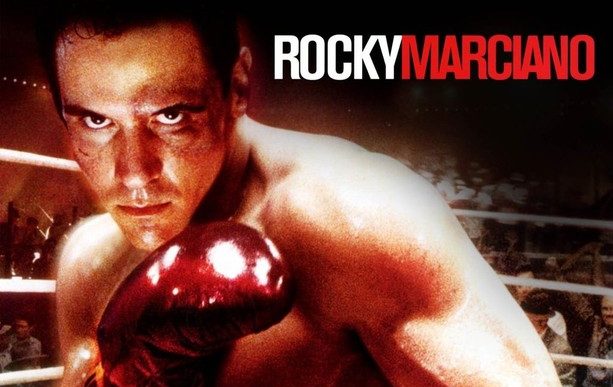
In Twenty 20-Fav, we’re spending 2025 examining the work of actor/director Jon Favreau. On this edition, we look at the made-for-TV movie Rocky Marciano, chronicling the life of the Brockton Bomber.
Born in Brockton, MA in 1923, Rocco Marchegiano found fame in the boxing ring and to this day is the only heavyweight boxing champion to retire undefeated. Naturally, there are a few caveats to that statement, but the fact remains that Rocky Marciano (as his promoters would later dub him) was one of the greats. So it seems weird that the boxer’s life story would be immortalized by a pair of TV movies instead of the big screen prestige treatment. The first was simply titled Marciano1, produced by ABC in 1979. The second, and the one we’ll be looking at today, is Rocky Marciano2, produced in 1999 for the premium cable network Showtime.
Of course, it’s not like we don’t already know Marciano’s story in broad strokes. The man and his life directly inspired Sylvester Stallone’s Rocky franchise3. In fact, this film comes from co-writer and director Charles Winkler, the son of Rocky producer Irwin Winkler. So there’s still a bit of a pedigree going on here. Consider this the scrappy little brother of the Rocky Balboa films.
Rocky Marciano tells the boxer’s life story in a series of nested flashbacks. When we first meet him, Marciano (Jon Favreau) is old and retired, receiving the Sportsman of the Century award from the Sons of Italy. Favreau’s wearing a bald cap and a fake horseshoe hairpiece and weirdly looking a lot like Jeremy Piven. The head of the organization gives him a check for two thousand dollars, and Marciano balks at it, demanding cold hard cash instead. The guy gives him five hundred bucks out of his wallet and Marciano calls them square. He says it’s nothing personal, but a lesson he learned from his father. “A man is nothing without cash.”
Then we flash back to Rocky’s childhood, where his father (George C. Scott in one of his final roles) works at a shoe factory. Young Rock brings dad his lunch at the factory just in time to see a guy get his hand caught and ripped off in the shoe press. Rocky and pops both agree that this factory is terrible and he’ll never work in a place like this. Flash forward to Young Adult Rock working at an ice and coal factory4, where he knocks a coworker out during a fistfight. His buddy Allie (Rino Romano) then convinces Rocky that boxing might be a viable career path. Rocky tests his mettle on the amateur circuit and repeatedly gets his shit wrecked, quickly realizing there’s more to boxing than just hitting a guy in the face. So naturally, he decides the only way to get better is by turning pro.
We then flash forward again to Old Rock, on the road doing promotional appearances and store openings for money. He calls home to tell his wife Barbara (Penelope Ann Miller) that he’ll be back in time for the birthday party their kids are planning for him. Flashing back again, we see the first meet-cute between Rocky and Barbara at a dance. He confesses he’s no dancer5, but she charms him onto the dance floor anyway. Thus begins a romance where Barbara repeatedly takes the lead, later introducing herself to boxing legend Joe Louis (Duane Davis) as Rocky’s fiancée. “Guess I’m getting married!” Rocky replies with a laugh and a shrug.
Rocky wins his first professional match by knockout, awkwardly dancing around the first few rounds before finally smashing his opponent’s face with a right hook that his handler says hits like a “falling safe”. (That right hook would become his trademark.) The movie then gives us a tongue-in-cheek montage of Rocky winning his next twelve bouts by knockout, set to Louis Prima singing “Pennies From Heaven.”
The boxing sequences are where this film really shines. Favreau got absolutely ripped for this, and you can see all the work he put into getting the boxing part of the role down. He looks like a completely different person from the pathetic schmuck we saw in Very Bad Things. If I have any one complaint, though, it’s in the sound design. (Yes, this is a silly nitpick, but that’s my job, right?) Every time Rocky lands a punch, we hear the same loud *thwack*. Over and over again. It’s almost identical to the punching sound used in the Indiana Jones films. Used sparingly, that sound really packs a wallop. It’s satisfying to see and hear Indy punch a Nazi’s lights out. But here? The repetition kind of takes away the magic of that sound. *thwack* *whump* *thwack* *whump* *THWACK!* I guess I should be grateful no one ever gets knocked out with the Wilhelm scream.
Then again, this being a low-budget TV production, we should give them a little bit of leeway. It’s not Favreau’s fault the punching sounds are so repetitive, just like it’s not his fault that his old man makeup makes him look like a character in an SNL skit. They’re working with what they got and more often than not things come together pretty well.
Rocky’s hot streak lands him a promoter in Al Weill (Judd Hirsch), who immediately signs him to a contract where half of Rocky’s earnings get ‘invested’ in ‘real estate’ that’s definitely not code for ‘paying off the mob’. Their relationship is a bit fraught due to this, because Rocky always remembered the lesson his pops taught him about getting everything in cash. We see him taking what cash he does make and hiding it behind a framed photo of his hero, Joe Louis. And speaking of pops, when Rocky returns home to visit, his father asks how he feels after winning twelve knockouts in a row. Modestly, Rocky responds that he feels “pretty strong.” Pops balks at this and says…

One of the pivotal fights in the movie comes when Rocky faces Carmine Vingo (Noah Danby) at Madison Square Garden. In the sixth round, Rocky knocks Vingo out cold, nearly killing him6. Rocky is so distraught by this that he helps carry Vingo to the nearest hospital on a stretcher. Vingo would eventually pull through, but Rocky insists on sitting vigil all night in the waiting room. The grief and despair is visible on Favreau’s face as Rocky’s forced to reckon with the reality of his profession. It’s a pretty powerful scene.
Later at Rocky and Barbara’s wedding, Weill delivers some bittersweet news: He’s finally landed Rocky a shot at the heavyweight title, but first he has to face his hero in the ring. Joe Louis announces he’s coming out of retirement to fight Rocky. (This in itself feels like the impetus for half of the movies in Stallone’s Rocky franchise.) Marciano is fucking livid about this, hating the idea that he’s not only going to meet his hero in the ring, but that he has to also defeat him? Bullshit. It’s even more bullshit as he’s training for the fight and not only do his promoters7 jerk him around about the money they’re making off the fight, but the reporters reveal themselves to be huge racists who just wanna see Louis take a beating.


The big fight between Marciano and Louis becomes the linchpin for the final act. Here, again, is a sequence that feels both indebted to the Rocky films, but also acknowledging that those films had to be based off of something, right? The boxing is tight and tense, the music dropping away and giving us a battle between the up-and-coming underdog and the past-his-prime legend. Rocky knocks Louis out in the eighth round, effectively ending his career for good. From there, Marciano’s career took off, but the film really doesn’t go into that at all.
Instead, we see Rocky many years later, now fast friends with Joe Louis, culminating in a heartbreaking sequence in a government retirement home. Louis lies on a cot in an otherwise empty room, the result of years of drug abuse and squandered money. Louis tells Rocky that if he’s got a family that loves him, he damn well better hold onto them, because once the money’s gone that’s all he’ll have left. This hits Rocky like a ton of bricks, having spent so much time on the road simply trying to make money for his family instead of spending time with them. As he leaves the facility, he hands the doctor a brown paper bag full of cash (his appearance fee from his most recent gig) and tells him to use it to take care of Louis, a goddamn national treasure. To the very end, the movie depicts Marciano trying his level best to do what’s right for the people in his life, whether that’s paying for Joe Louis’s medical care, or buying a shitload of oyster shells so his father can finally have a proper bocce ball court.
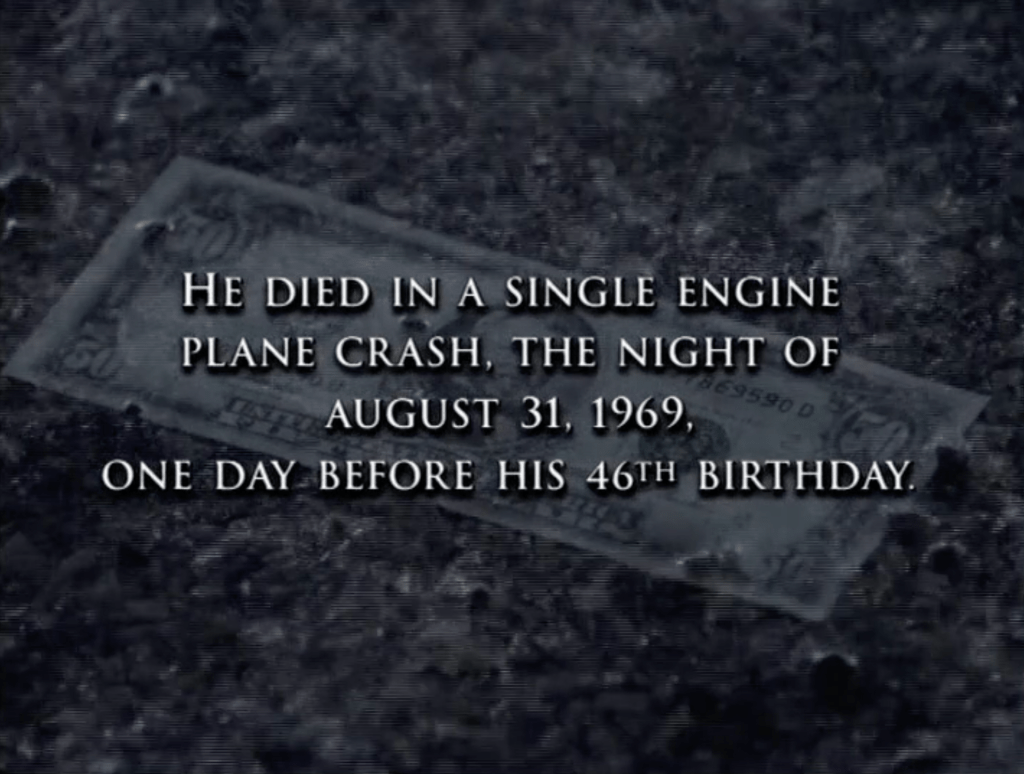
The film ends with Rocky boarding a small, single-prop passenger plane to take him home. As the plane takes off in a driving rainstorm, we’re told in an ending title card that that plane would eventually crash. Rocky Marciano’s plane went down just short of the runway, killing everyone inside. The camera pans down and focuses on a fifty dollar bill lying in a rainy puddle. Is this meant to suggest that Marciano’s ultimate downfall was money? If it is, that’s kind of a slap in the face, as his only real sin was working too much to provide for his family. So much of the film revolves around Marciano sticking to his principles, whether it’s his Italian Catholic upbringing or his work ethic and determination to not wind up like his father, so this being the final shot of the movie really feels undeserved.
THE FAVREAU DIMENSION
Ultimately, Rocky Marciano is a pretty by-the-book sports biopic, but its strengths lie almost completely in Jon Favreau’s portrayal of the boxing champ. Favreau gives us the scrappy young Rocky who can barely stand up straight in the ring, then the bulky, self-assured heavyweight who can beat anyone, then finally the tired, retired boxer who just wants to make his money and go home. That simmering rage we saw in Swingers finally gets a chance to come out as Favreau throws everything he has into this role. And he took it seriously, too, training for months not only to get his body in shape, but to learn how to move like Marciano and box with the best of them. That’s some real dedication for what was ultimately a flash-in-the-pan TV movie, but it shows how far Favs is willing to go for the sake of the production. If there’s any reason to seek this movie out, that’s it right there. Jon Favreau makes this movie, full-stop.
FINAL RATING
3 stars (out of 5). S’not bad.
NEXT TIME: Batman Forever.
- It’s not available for streaming, but you can watch it on YouTube with Portuguese subtitles.
↩︎ - This one’s streaming on a couple platforms, but is also available on YouTube.
↩︎ - Marciano’s influence on the Rocky series runs deep. The plot of 2006’s Rocky Balboa is directly based on a computer simulation run in 1969 to determine who would win in a fight: Rocky Marciano or Muhammed Ali.
↩︎ - The Brockton Ice & Coal Company, today known as Eastern Ice and still very much in business.
↩︎ - I’ve seen Swingers. I know that ain’t true.
↩︎ - I wonder if this inspired the scene in Rocky IV where Ivan Drago kills Apollo Creed in the ring. “If he dies, he dies.”
↩︎ - Among them Tony Lo Bianco, who portrayed Rocky Marciano in the 1979 film. ↩︎

Leave a comment