
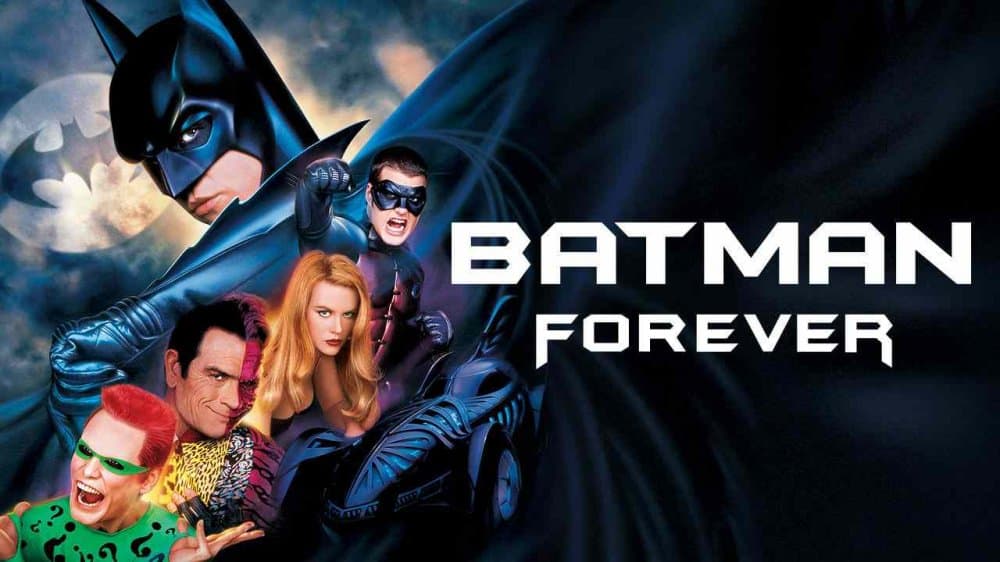
In Twenty 20-Fav, we’re spending 2025 examining the work of actor/director Jon Favreau. In memory of the late Val Kilmer, we’re going to look at Batman Forever, which features Jon Favreau in a non-speaking role for exactly five seconds.
I truly never intended to cover Batman Forever in this series about Jon Favreau. He has maybe ten seconds of screen time and not a single line of dialogue. What is there to even talk about? But then, with the passing of Val Kilmer earlier this week, I figured what the hell? When else am I ever gonna get the chance to write up My Favorite Batman?
It’s been said that your favorite Batman is whichever one came out when you were nine years old1. And that very much holds true here. Batman Forever came out in the summer of 1995 and put a stamp on my nine-year-old brain that I have spent the last thirty years trying to scrub off. Call it nostalgia goggles, call it Stockholm Syndrome, call it whatever you want, but the fact remains: I fucking love Batman Forever. It was the first real blockbuster event I can remember getting swept up in as a kid. I saw the movie, had the soundtrack album, I even played the terrible Super Nintendo game. I know it’s kinda gauche for a film review to use so many I-statements talking about the author’s own personal experience, but with this one it’s kind of unavoidable. Batman Forever was my entire world for a good couple years, a spell that was only really broken with the release of Batman & Robin.2
But sandwiched in between Tim Burton’s two iconic Batman films and Joel Schumacher’s neon nightmare, there’s Batman Forever. It’s a movie that is peak 90s in every way that matters, focus-grouped to death and engineered to appeal to as many demographics as humanly possible. And yet, for as aggressively as Warner Bros. pushed Schumacher to make the blandest, most faceless corporate product he could, that still couldn’t stop him from picking up where Tim Burton left off and running in even more bizarrely theatrical directions.
Tim Burton’s original Batman, of course, was a cultural phenomenon. That film’s Batman logo is still one of the most widely recognized symbols in the world. (I literally saw that symbol on a kid’s t-shirt just yesterday. It’s everywhere.) It cemented the idea of a darker, more adult-oriented Batman in the mainstream consciousness, a notion that Burton pushed even further in the 1992 follow-up Batman Returns. That film famously rubbed corporate sponsors and parents alike the wrong way with its more violent, sexualized tone. And while Returns made plenty of money, the studio clearly wanted to change course and so parted ways with Tim Burton. While Burton stayed on as a producer, WB tapped Joel Schumacher to direct based on the strength of The Client.
With Burton gone, Michael Keaton also declined to return, so the hunt was on for a new Batman. The studio offered the role to Ethan Hawke, a role he still regrets turning down3. Joel Schumacher whittled down his shortlist of actors to William Baldwin, Daniel Day Lewis, Ralph Fiennes and Val Kilmer. Schumacher ultimately chose Val Kilmer, having seen his work in Tombstone and deciding his movie also needed a huckleberry. Kilmer apparently said yes to the film sight-unseen.
Akiva Goldsman (who worked with Schumacher on The Client) was brought on to rewrite a script from Lee & Janet Scott Batchelor. The final script finds Bruce Wayne (Val Kilmer) confronting repressed memories surrounding the deaths of his parents, the event that ultimately led him to becoming Batman. Bruce wrestles with his dual identity, while at the same time hot on the trail of former district attorney-turned-criminal mastermind Harvey “Two-Face” Dent (Tommy Lee Jones, also from The Client). Two-Face’s crime spree is predicated on the simple desire to draw out Batman and murder him.
At the same time, Bruce makes an enemy at Wayne Industries in the form of employee Edward Nygma (Jim Carrey, in the middle of the most lucrative year any film actor has ever had). Nygma invents a headset that beams TV signals directly into the human brain, with the added side effect of sapping their brainwaves and making himself smarter. Bruce rebuffs Nygma’s request for funding, which leads to Nygma setting a plan in motion to stalk, taunt and humiliate Bruce. Nygma turns himself into The Riddler and seeks out Two-Face to help him steal enough money to build a giant brain box, his entire plan predicated on the simple desire to draw out Bruce Wayne and murder him.

Then there’s the C-plot involving Dick Grayson (Chris O’Donnell), whose family of trapeze artists were all killed by Two-Face at the Gotham Circus. Bruce agrees to take him in, seeing a kindred spirit and hoping to dissuade him of his desire to kill Two-Face out of revenge. Dick nevertheless dubs himself ‘Robin’ and asks Bruce to train him, his ulterior motive predicated on the simple desire to draw out Two-Face and murder him. (Batman has a secret plan for killing Two-Face himself so as to absolve Dick of actually committing the crime.)
Then there’s the D-plot involving Dr. Chase Meridian (Nicole Kidman), brought to Gotham by Commissioner Gordon (series stalwart Pat Hingle) to help investigate and study Two-Face. This turns out to be completely unnecessary, because Batman already has Two-Face perfectly figured out, and is simply biding his time waiting for the right opportunity to apprehend him. I think Gordon just invited her in because he knew the movie needed another blonde lady to swoon over Batman and have a will they/won’t they romance with Bruce. And can you believe it? Gordon was right.
Chase being a psychologist also gives us an in to the movie’s Bruce Wayne plot, which finds him recovering repressed memories from the night his parents were killed. He tells Chase that he sees flashes of himself falling into a cave and seeing something horrible fly towards him in the dark. In describing these repressed memories to her, he’s so close to admitting he’s actually Batman, but what Bruce Wayne winds up telling us is that at some point in his career as the Caped Crusader, he forgot why he became Batman. Bruce’s journey of discovery takes him from questioning his own identity, to declaring his retirement after failing to save the Graysons, to finally coming out of retirement a week later and stating that instead of feeling obligated to be Batman, he chooses to be Batman. Let’s ignore that he makes this decision in a situation where he’s obligated to be Batman in order to save Chase and Dick from certain death, but also because Two-Face and The Riddler broke into his house, kidnapped his girl and blew up his basement, and he took that personally.
The plot of Batman Forever is admittedly kind of a mess. It’s so thin that the movie features multiple scenes where Batman is just driving around and runs into Two-Face and his goons on the street just to pad out the runtime. These sequences are still a ton of fun, elevated by Elliot Goldenthal’s brassy, operatic score. The way the trumpets trill as Batman evades Two-Face, who screams out as the batmobile speeds away, feels pulpy and cartoonish. It feels more than a little indebted to Warren Beatty’s Dick Tracy, itself already desperately trying to crib the style of Tim Burton’s Batman. It’s a game of cinematic telephone.
But it doesn’t stop there. Schumacher uses diegetic lighting all over the place in this movie. Sets are littered with random, swirling spotlights and lasers going every which way, turning indoor sets into these huge performance spaces where a fight sequence or a dance number is liable to break out at any moment. Coupled with Goldenthal’s perversely whimsical score, and performances from Jim Carrey and Tommy Lee Jones that seem intentionally pitched to the cheap seats, Batman Forever takes on the feel of a rock opera. No other Batman movie before or since has landed on that style, and I really wish someone would pick up that baton and really go for it sometime.
I think more than anything else, that’s what I love so much about this movie, even thirty years later. It’s not the story or it’s characters. It’s the design of the film, the way everything gets put together and arranged into this peak-90s studio extravaganza. The production design by Barbara Ling (who also worked with Schumacher on Falling Down) has a distinct Tim Burton-meets-Blade Runner feel, where all of the gigantic statues from Batman Returns have been given a neon-infused overhaul. It’s bright and gaudy and dirty in the way that only a very expensive Hollywood production can look.

I love the score in all its silly, operatic splendor, but I really love the soundtrack album. I have a podcast all about it right here if you feel like listening to a deep dive on it. Seal’s “Kiss From a Rose” is an inscrutable classic, but I always find myself gravitating toward U2’s “Hold Me, Thrill Me, Kiss Me, Kill Me”. It rings out over the closing credits and fits the dark/silly balancing act the film teeters on perfectly.
Batman Forever is 100% a product of its time, and I will fully admit to having some thick nostalgia goggles for it. I think the performances vary from distressingly flat—the movie doesn’t seem to know what to do with Val Kilmer, and vice versa—to obnoxiously over the top. Tommy Lee Jones appears hellbent on acting crazy circles around Jim Carrey in every scene they share (made even more apparent when you know the story behind Jones’ hatred for his co-star). At the same time, I think the decision to cast Jim Carrey in the movie at all sort of hijacks any other plans the movie might have had. At this specific moment in time, any notion of telling a story about Bruce Wayne or Dick Grayson, or even Harvey Dent, went out the window in order to let the most popular actor in the world run wild and do whatever he wanted.
Superhero movies have gone on to bigger and better things since 1995, becoming so entrenched in the culture that at times it seems like that’s all there is anymore. But for as ubiquitous the genre is now, there will never be a time again like the mid-90s, when the mandate seemed to be for every comic book under the sun to receive the weirdest, most garishly designed adaptation imaginable. Batman Forever is the poster child for all of that nonsense. And god help me, I love it.
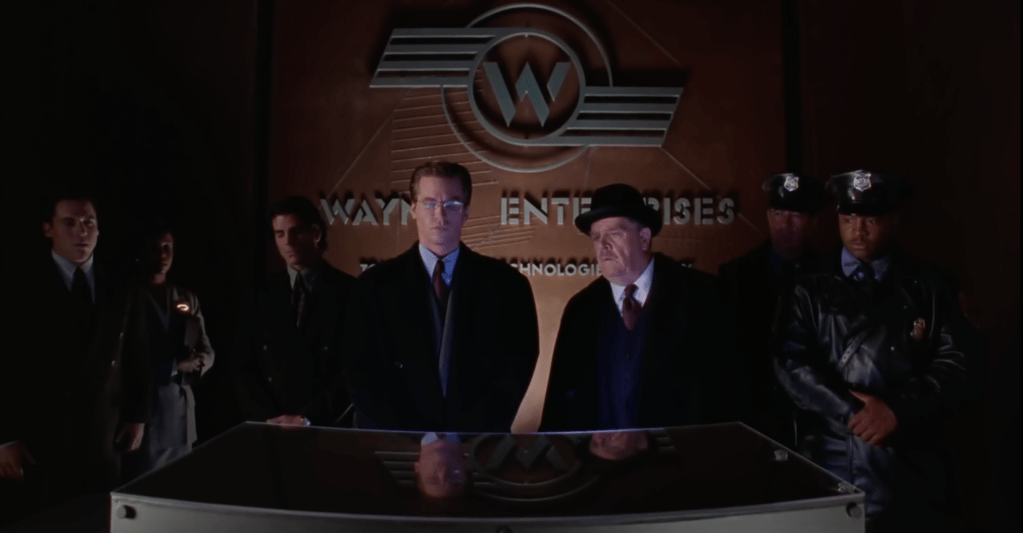
THE FAVREAU DIMENSION
FINAL RATING
4 stars (out of 5). S’great. I love it.
NEXT TIME: Love? And Sex? In this economy?

Leave a comment