
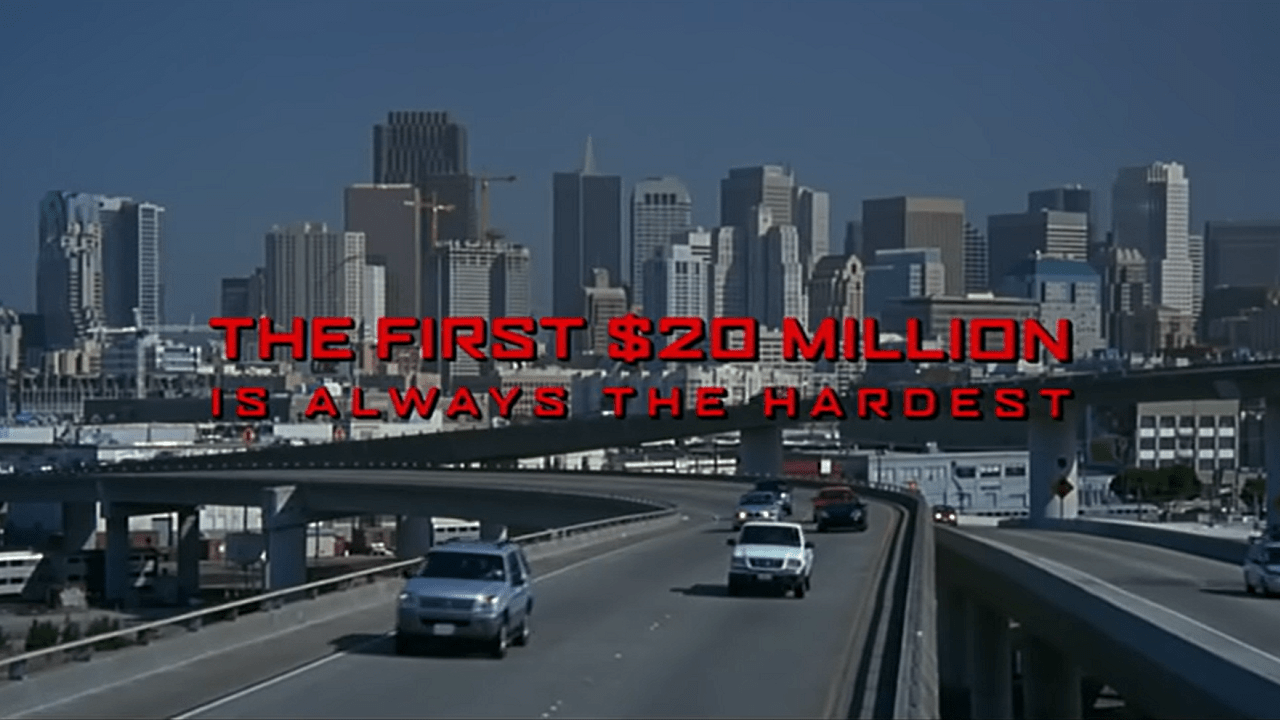
In Twenty 20-Fav, we’re spending 2025 examining the work of actor/director Jon Favreau. This week, we take a look at The First $20 Million Is Always The Hardest, a low-rent comedy about fame and fortune in Silicon Valley.
The San Francisco Bay Area is ripe for parody for a lot of reasons, but chief among them might be the gonzo tech culture that calls the Bay Area home. Mike Judge spent six whole seasons lampooning that culture on HBO’s Silicon Valley. And before Silicon Valley, there was Po Bronson’s “The First $20 Million Is Always The Hardest”, a novel satirizing the businesses and people who infested every corner of San Francisco’s tech sector in the mid-to-late 90s right before the whole Dot Com boom imploded. Time Magazine called the novel the “‘Primary Colors’ of Silicon Valley”, a comparison I’m sure made a whole lot more sense in 19971.
Then there’s the film adaptation, which comes courtesy of co-screenwriters Jon Favreau and Gary Tieche, and British director Mick Jackson. Among Jackson’s more notable credits include the nuclear war drama Threads, the Whitney Houston star vehicle The Bodyguard, and Volcano, the movie where Tommy Lee Jones outruns slow-moving lava through the streets of Los Angeles. To put it bluntly, these films could not possibly be more different. I can’t decide if that makes The First $20 Million Is Always The Hardest2 stick out like a sore thumb in Jackson’s filmography, or if it’s just another feather in his eclectic cap. Depends on how generous you’re willing to be to a shitball early-aughts bro comedy.
The film opens with Silicon Valley marketing whiz-kid Andy (Adam Garcia), who randomly decides to quit his job at a lucrative tech firm and go work for La Honda Research Institute, a valley think tank where engineers work on their dream projects in the hope of creating the Next Big Thing. La Honda honcho Francis Benoit (Enrico Colantoni) puts Andy in charge of a project to create the PC99, a home computer that anyone can afford for the low, low price of $99.
To achieve this impossible task, Andy rounds up the last remaining engineers not assigned to any other projects: World-class hacker Salman Fard (Anjul Nigam), who constantly talks about his online girlfriend who’s totally real, you guys. Then there’s Darrell Claxton (PCU‘s Jake Busey), a huge germophobe introduced playing an electric guitar with laser strings. Finally there’s Curtis Reese (Ethan Suplee), AKA ‘Tiny’, who has crippling social anxiety and is introduced riding a Vespa scooter. All of these quirks will come into play later, except for the scooter, which is only here because a big fat guy on a little scooter is the height of comedy in this film.
Anyway, while Andy and his crew of misfits cobble together a cheap and easy computer box, he also gets to know his boarding house neighbor Alisa (Rosario Dawson). A struggling sculptor, Alisa is the polar opposite of Andy, seeming perfectly content doing absolutely nothing with her life. He asks her out to a fancy restaurant, she hits back with microwave noodles in her boarding room. It’s cute but mostly perfunctory. I really get the feeling Dawson’s only in this movie so that the nerds can call her Andy’s ‘docking station’. (This is an awful joke, so naturally, they do it like four or five times.)
The guys are given three weeks to work up a prototype of the PC99. Andy walks into the office one day to catch the guys ogling a hologram they’ve mocked up of one of their lady colleagues dancing like a Vegas showgirl. The next night, Andy has a sex dream about Alisa as the hologram dancer, because we haven’t gone completely off the skeevy cliff just yet… But then Andy wakes up with a brilliant idea: What if they used the hologram projector as the monitor? Toss in a pair of virtual reality gloves, rip out the processors and have the computer run all its software off the internet3, and voila! The PC99!
It’s right about here where you can start to feel current events creeping into the plot of a story originally written in 1997. The Dot Com bubble burst in early 2000, putting a whole bunch of programmers, engineers, and tech nerds out of a job. Companies began downsizing, cutting back on funding, all that jazz. And the movie reflects this too. After the guys go through all their pitch meetings, they retool the product and try again, only now the market’s crashed and companies aren’t interested in investing in this computer shit at all. So when one of Andy’s bosses goes to the president of the company and tells him what they’ve got, the guy balks at the idea of cheap hardware. “Market’s on the skids and we’re cutting back!” He says most of their profits come from the hardware, so why on God’s green earth would they sell something for cheap?
The idea of a $99 computer wasn’t entirely outlandish in 2002. Do you remember the old TV ads for PeoplePC? They featured a cute little kid acting like he was running for president on a single platform: Making budget-priced PCs and internet access available to everyone for the low, low price of $24.95 per month. That comes out to roughly $300 a year, which is still three times more than the cost of the PC99, but not unreasonable. Nowadays? You can get a decent streaming tablet for anywhere from $20 to $50. The idea of cheap hardware eventually did find it’s niche. It may have been toddlers who use it for nothing but watching Bluey, but the great thing about toddlers is they’re making more of ’em all the time. You’d think the PC99 would be a revolution in cheap, gateway computing for first time users. And I realize at this point that what I’m really talking about is Apple’s iMac. That’s what our guys are basically trying to build. And they kinda do, it’s just that instead of looking like a TV, theirs looks like the base of a blender with all the buttons sanded off.

So naturally, after the guys fail to market the PC99 to literally anyone in town, Francis swoops in, buys it from them for a song after the market’s crashed and selling it himself at ten times the price4. Shenanigans ensue where our guys find an extremely obvious loophole in their contract to build an even bigger, better version, scam Francis into thinking he’s pre-sold hundreds of thousands of units—by… preordering hundreds of thousands of units? Posing as big government agencies? Aren’t they on the hook for all those? Or at the very least guilty of some kind of fraud? I dunno, who cares—and hijacking his product launch with their own product that comically just kinda looks like a microphone. Hey, at least it’s not a blender.
The important thing is that the dingus works. Its hologram desktop can be manipulated with your fingers, which is basically the same technology you see Tom Cruise using in Minority Report. Incidentally, Minority Report beat this film to theaters by exactly two weeks.
Hey, speaking of theaters, you wanna know a fun statistic? The First $20 Million was released in only two theaters at the end of June 2002. It made $5,491 at the box office. That’s roughly 0.03% of the film’s $17 million budget. Wikipedia says that’s enough to qualify this as one of the biggest box office bombs of all time. That’s not quite Zyzzyx Road bad, but still pretty rough5. As such, this one’s really hard to come by these days. You can’t stream or even rent this one anywhere, unless you know how to access Disney Plus in Japan (where this movie is inexplicably streaming).
And honestly? The movie kinda deserves that. It’s a movie in the Revenge of the Nerds mold where the awkward, nerdy guys get one over on the mean, less nerdy guys by pulling a scheme and standing up for themselves and haven’t we had enough of that by now? It’s clear the culture still had a long way to go in depicting geeky types as anything other than greasy, socially awkward horndogs in 2002, and even The Big Bang Theory was years away at this point. This is a movie that really didn’t need to exist in 2002, and really has no reason to exist now. It barely had anything to say about the scene it portrays, which has been mined for more scathing commentary and bigger laughs elsewhere in the years since. The Dot Com bubble burst, but now we’re in an era where the tech sector is literally everything, and they’re trying to cram AI everything down all of our throats. So no, you can miss me with all of this.
THE FAVREAU DIMENSION
The First $20 Million appears to have been a purely work-for-hire gig for Favreau, who co-wrote the screenplay with Gary Tieche, adapting Po Bronson’s novel. There are some vague similarities between this and Favreau’s own pet projects, Swingers and Made. A pack of idiot hustlers trying to scrape by and make something of themselves seems to be a story that resonates with him. Also, the fact that Andy repeatedly refers to his team as “Iron Men” throughout the film cannot be overlooked. If that ain’t foreshadowing for this column… I just don’t know what is.
FINAL RATING
1 star (out of five). So, so bad.
NEXT TIME: Favreau’s first brush with Marvel.
- “Primary Colors” was loosely based on the first term of President Bill Clinton. At least that film adaptation came out while the subject was still relevant.
↩︎ - Which, for the sake of brevity, we’ll just shorten to The First $20 Million for the rest of this review.
↩︎ - The idea of cloud computing still kinda seems like magic here in 2025. It works, but I couldn’t tell you how. So in 2002 this really must have seemed like cuckoo bananapants wizardry.
↩︎ - $999, which is still less than the retail price of the original iMac.
↩︎ - Zyzzyz Road made $30. Thirty Dollars. ↩︎
