
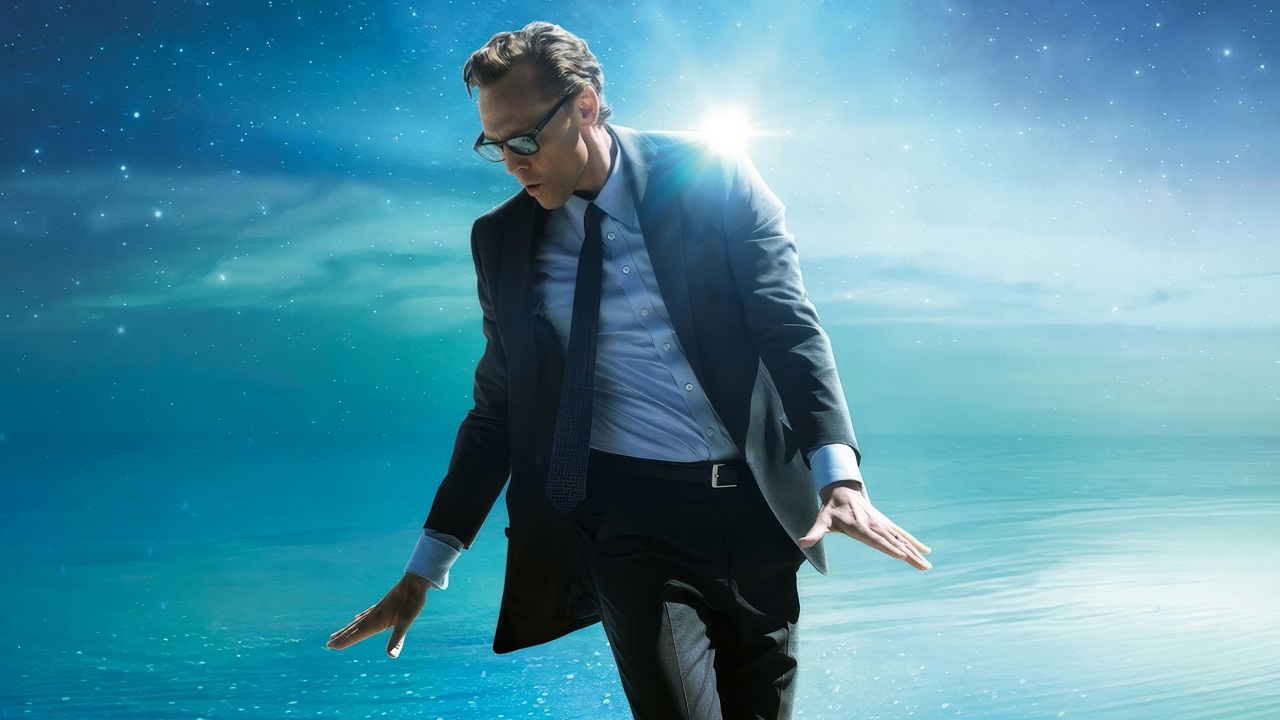
[FEDERALLY MANDATED SPOILER ALERT FOR A MOVIE ABOUT TOM HIDDLESTON DANCING.]
I’ll be turning 39 next month. In my almost 39 years on this stupid little planet, I feel like I’ve done fairly well for myself. I have a family, a spouse whom I love, a home we’ve created together, and two pets who rely on my ability to open a ziplocked bag for their daily meals. By most metrics, that’s it. The game’s over, and I’ve won. But you’re also fooling yourself if you think the game of life is about just the start and finish; that the signposts of a life lived are what matter. Truth is, it’s all the pitstops and random incidents along the way that give the journey its character. That goes for all of us; not just the ones suffering from a cringe-inducing case of Main Character Syndrome.
That’s the heart of Mike Flanagan’s The Life of Chuck, the latest entry in his bid to become the Official Adapter of All Things Stephen King. Chuck, based on a novella featured in King’s “If It Bleeds”, concerns a mild-mannered accountant named Chuck Krantz (Tom Hiddleston), whose life is cut short at the relatively young age of 39. (Oof…)
This fact is established at the end of act one—or three, depending on how you look at it, because this story is told in backwards order—and becomes the emotional lynchpin of the entire affair. So, y’know… Have tissues at the ready.
As the story opens, we find out that the world is slowly unraveling. California has fallen into the sea, the internet is down (“PornHub is gone…” a distraught David Dastmalchian intones), and the stars are starting to fade from the night sky. No one knows what the hell’s going on, or even why. The mysterious appearance of billboards and TV ads thanking some guy named Chuck Krantz for “39 great years” does little to quell the fear in schoolteacher Chiwetel Ejiofor and ER nurse Karen Gillan. We soon learn that these people are little more than the lingering memories of Chuck at the moment his brain dies of cancer.
Seemingly aware of what a cosmically depressing bummer this is, the movie switches gears quickly to six months earlier, as Chuck attends a CPA convention. Having an afternoon to himself, he wanders down a city street and encounters a busker (Taylor Gordon) drumming on a street corner. All of a sudden, the beat gets to him, and Chuck busts out a impromptu dance routine. Her drumming fuels his dancing, and his steps challenge her to play more complicated beats. Soon a crowd gathers to watch and Chuck invites Janice (Annalise Basso) from the crowd to dance with him. This whole sequence is a showstopper, ten minutes of unexpected joy that show us just how much fun life can be when we give ourselves over to it. There’s a brief will-they/won’t-they moment between Chuck and Janice, but our narrator (Nick Offerman, the stealth MVP of the entire film) reminds us Chuck has a wife and kid back home, and also that he’ll be dead in six months.
Flashing back even further, the film finally settles into its main story. We learn that Chuck’s parents died when he was very young, forcing him to live with his grandparents Albie (Mark Hamill) and Sarah (Mia Sara), whose own interests in accounting and dancing, respectively, shape Chuck into the man he’d grow up to be.
Looking back at the last couple of paragraphs, it’s telling which of these segments I found most compelling. The story of young Chuck learning to dance from his grandma and eventually becoming the toast of the school dance courtesy of his gym teacher (Samantha Sloyan) and dance partner (Trinity Bliss) is fun and uplifting, but something about it feels pretty… I dunno. Typical? Feels like a story we’ve seen a dozen times already.
Meanwhile, Tom Hiddleston playing a mild mannered accountant whose days we already know are numbered? And seeing him living it up in spectacular, choreographed fashion? That’s powerful. That’s inspiring. That‘s the shit I thought we’d be getting more of from The Life of Chuck. But that’s also not what Flanagan and King are playing at.
In telling the story backwards, we catch a glimpse of Chuck’s mind at the moment of death, all his thoughts, memories, and collected musings rattling around, ping-ponging off one another as the whole thing circles the mortal drain. It’s disconcerting as Chiwetel Ejiofor looks up at a billboard of Chuck while we hear the Spencer Davis Group’s “Gimme Some Lovin'” over the radio. But then in telling the story backwards, we also get to discover why and how any these things populated his warehouse of memories1 in the first place. “Gimme Some Lovin'” in particular, pops up a few times in the film, culminating in the big school dance number toward which the entire film inexplicably builds.
I went to a lot of middle school dances in the late nineties, and none of them ever played “Gimme Some Lovin'”. None of them ever played anything older than 1988, now that I think of it. Chalk this one up to being a holdover from King’s novella, which I’m assuming was drawn more from his own childhood. King would’ve been 18 in 1966, when that song came out, so it’s entirely possible he heard it at at least one school dance.
I don’t even know why I’m getting so hung up on this fact in the first place. The fact that you and I exist in the same small pocket of history that produced Spencer Davis, Steve Winwood, and Stephen King in the first place is a blessing all on its own. It’s been four days since seeing The Life of Chuck, and I’ve spun “Gimme Some Lovin'” more times than I care to admit. It’s a fucking classic. If that turns out to be the last song I hear before I die, then that’s not a bad way to go.
But let’s not get too far down that train of thought. I had The Life of Chuck built up to me as an elderly Stephen King’s attempt at writing his own It’s A Wonderful Life. That’s not entirely accurate, these stories are doing two very different things, but I can see how one would draw that parallel. Capra’s film is a plea for community in a time when the demon of big business began to rear its ugly head. Chuck, on the other hand, is a story about the life of the mind2. The people we meet, the experiences that shape us, the songs that move us. Everything adds up to create a person that contains multitudes, as Walt Whitman (the story’s patron saint) would say. And while the film ultimately ends on a horror twist befitting a King story, the underlying theme still remains. We don’t often get to choose the things we remember in this life, but if all you take from The Life of Chuck is Tom Hiddleston dancing and “Gimme Some Lovin'”, even if those two things aren’t related? That’s more than enough.
FINAL RATING
4 stars (out of 5). S’good.

Leave a comment