

In Twenty 20-Fav, we’re spending 2025 examining the work of actor/director Jon Favreau. This week we discuss a bona fide game-changer. It’s Favreau’s biggest film to date. It’s the birth of the Marvel Cinematic Universe. It’s wholly responsible for the moviegoing landscape as we know it today. It’s time to talk about Iron Man.
It’s crazy to think that, in 2008, none of this was a sure thing. A summer blockbuster about Marvel second-stringer Iron Man, starring a one-time Saturday Night Live performer with a history of substance abuse, was not something that should have worked, nor was it anything that anyone had faith in whatsoever. The burgeoning superhero genre had been lucrative, but there were just as many misses (see: Daredevil) as there were hits. Iron Man was the make-or-break moment for Marvel Comics, which had staked its entire future on the idea of becoming its own movie studio. And with Jon Favreau at the helm, Iron Man became the cornerstone of a franchise that would eventually consume the entire media landscape, and continues to do so to this day.
That’s a hell of a lot of baggage to place on a zippy little action film about a guy in a robot suit. Fortunately, Iron Man works not because of its baggage, but rather in spite of it. It was the right movie made by the right people, released at exactly the right time. Released on May 2, 2008, Iron Man came out the day I graduated from college. The fact that the franchise it kicked off is still going strong as I’m pushing 40 (good lord…), is a testament to what a foundational text Iron Man has become. This is the lode-bearing pillar of the entire MCU, one that is continuing to pay off long after its central hero exited the scene.
So once again, we can’t properly appreciate Iron Man as it exists until we understand how it came to be. Strap yourselves in, boys and girls, cuz this is the longest entry in this column yet. Here we go…
THE BACKSTORY
For much of the 2000s, Marvel Comics found itself struggling to pay off its debts. Producer Avi Arad was convinced that the company’s salvation was in the feature film business. Less concerned with producing the films himself, Arad brokered deals with other studios to produce films that would allow Marvel to cash in with accompanying lines of action figures1. When 20th Century Fox pushed the release date of Bryan Singer’s X-Men six months ahead of schedule, Marvel was left in the lurch, struggling to catch up with a toy line to meet the moment. As a result, toy sales off the back of that film were low, and Arad was determined not to make that mistake again. He realized Marvel needed more control over when and how its films were produced if it was ever going to make a profit.
Enter Kevin Feige, who at the time had been working as an intern for Lauren Shuler Donner, producer of the X-Men films. Feige had proven himself a font of information regarding the comics, becoming Donner’s unofficial right-hand in dealing with the studio and production teams. His work steering the ship impressed Avi Arad, who eventually offered Feige a job working on future film endeavors. Feige knew that with many of Marvel’s heavy hitters were already contracted to other studios—X-men at Fox, Spider-Man at Sony, Hulk at Universal, etc.—all they had left to work with was the B-team. The also-rans. The Avengers. There was an opportunity here, but in order to make any films at all, Marvel was going to have to raise some serious coin.
David Maisel, one-time apprentice to former Disney CEO Michael Ovitz, had an idea about that: If Marvel could raise enough capital to set up its own studio, they could produce films however and whenever they saw fit. It was a huge risk, one that forced the company to put up the rights to many of its titles as collateral. Maisel took his pitch to Wall Street, securing just over half a billion dollars from Merrill Lynch with the caveat that Marvel at least attempt to raise 30% of the film budgets themselves2. Marvel’s plan quickly took shape: With $525 million, they had enough money in the bank to produce four feature films, hoping that at least one of them would hit the jackpot at the box office. The plan was to build towards a future team-up film starring all of the Avengers, assuming the gamble paid off.
But where to start? Marvel began conducting focus groups among children to see which Avengers might be the most toyetic3. They apparently just described various Marvel heroes to the kids, who all instantly agreed that Flying Robot Man was, hands-down, the coolest. I mean, of course they would. The only thing boys love more than robots is video games about robots. So with that little bit of market research in hand, Marvel settled on making Iron Man their first feature film, followed closely by The Incredible Hulk. Strictly on the basis of what would sell the most toys.
THE FAVREAU DIMENSION
The Favreau Dimension is moving up to the middle for this piece because this is where our boy Favs comes into play. Favreau had been one of Marvel’s top choices for the project from the beginning, based entirely on the strength of his work on Elf. (And I’m sure his working relationship with Avi Arad from the set of Daredevil didn’t hurt either.) His pitch for the movie required a level of plausibility. He wanted everything to feel as real and tactile as possible, that you could believe someone could actually build a robot suit and fly around in it. And more importantly, he wanted audiences to feel the thrill of doing this alongside its hero, Tony Stark.
It was Favreau who lobbied hardest for Marvel to cast Robert Downey, Jr. as Stark, and when the studio balked at the idea he (reportedly) leaked the casting to the press. The resulting outburst of fangasms caused Marvel execs to change their tune and cast Downey with the quickness, cementing the snarky-but-lovable tone of the MCU for the next two decades.

Favreau worked closely with Downey on hashing out not just the character of Tony Stark, but the dialogue and banter on a daily basis as well. Iron Man is famous for going into production without a finished shooting script, many scenes taking shape on the fly in the middle of production. Everyone knew the big beats the movie had to hit, who the heavy was going to be, the love interest, all that fun stuff. Favreau and Downey, however, spent hours each day building out the day’s scenes. It’s not unlike the way Michael Bay, Will Smith and Martin Lawrence workshopped Bad Boys on the fly. (It also, apparently, drove Jeff Bridges crazy.)
THE FILM ITSELF
Iron Man opens quietly, almost as though it’s afraid to announce itself too arrogantly. The Marvel Studios logo flips its now-iconic comic book pages in silence before we see a military convoy driving through the desert4. Here’s where we meet Tony Stark (RDJ), billionaire weapons manufacturer, orphaned tech whizkid and part-time drunken philanderer. He doesn’t know it yet, but he’s about to get blown up by terrorist insurgents in Afghanistan, brandishing weapons built by Stark’s own company. (This was right at the tail end of the second George W. Bush administration, and it shows.)
Right away, this cold open sets up Stark’s character, his internal conflict and his driving motivation through the rest of the film in a few very economical minutes. Remember, Iron Man came out the summer after Michael Bay’s Transformers, which wastes a metric assload of screentime explaining things everyone already knows. Even though this was already the umpteenth superhero movie produced in the aughts, this felt like a breath of fresh air. It felt like Marvel trying to take themselves seriously, and asking us to trust the process.
And it works. Once Tony gets blown up, bleeding out under the desert sun, we flash back a day and a half to see how Tony arrived at this situation. In short order, we meet his business partner Obadiah Stane (Jeff Bridges), who accepts a humanitarian award on Tony’s behalf from his buddy and Air Force liaison James Rhodes (Terrence Howard). Tony, who was busy at a Las Vegas craps table instead, then fields some pressing political questions from Vanity Fair journalist Christine Everhart (Leslie Bibb) before somehow talking her into bed with him. The following morning Christine meets Tony’s personal assistant Pepper Potts (Gwyneth Paltrow), who kicks her out just in time to also force Tony to the airport, where he’s supposed to fly with Rhodes to Afghanistan and demonstrate to the US military brass the latest super-missile from Stark Industries.

Once again, it’s an awful lot of character building and exposition, but the movie handles it all so deftly that it’s hardly a complaint. We’re thrust into this world quickly, whisked along as Tony banters with literally everyone he meets. He’s clearly got the charm; he’s got the devil-may-care attitude; he’s got enough fuck-you money to lead a billion dollar weapons manufacturer and also spend his days tinkering with his hot rods at home all day. Tony’s got it made in the shade, which makes the fall even more dramatic when he finally wakes up in the present to find himself held prisoner in a cave in Afghanistan. He’s been captured by a group calling themselves The Ten Rings, already seeding plot points that the MCU will pay off like a decade from now (and even then, only tangentially). Also, to make matters worse, there’s an electromagnet sticking out his chest, tethered to a car battery to keep bomb shrapnel from sinking into his heart.
During production, the word Favreau kept coming back to was ‘plausibility’. It wasn’t enough to just show a glowy thing sticking out of Tony’s chest. We needed to see how it was surgically implanted, and it was equally necessary to show the pieces all fitting together to form the now-iconic suit. That suit, by the way, is the work of Stan Winston (who also created the Zorgons for Favreau’s Zathura), and it’s a fantastic piece of work. Even viewing it in 2025, there are still moments where it’s hard to tell where the physical model/costuming end and the CGI begins. You believe in the Iron Man suit screwing itself together, which is not something you could ever say about any of the Transformer movies.
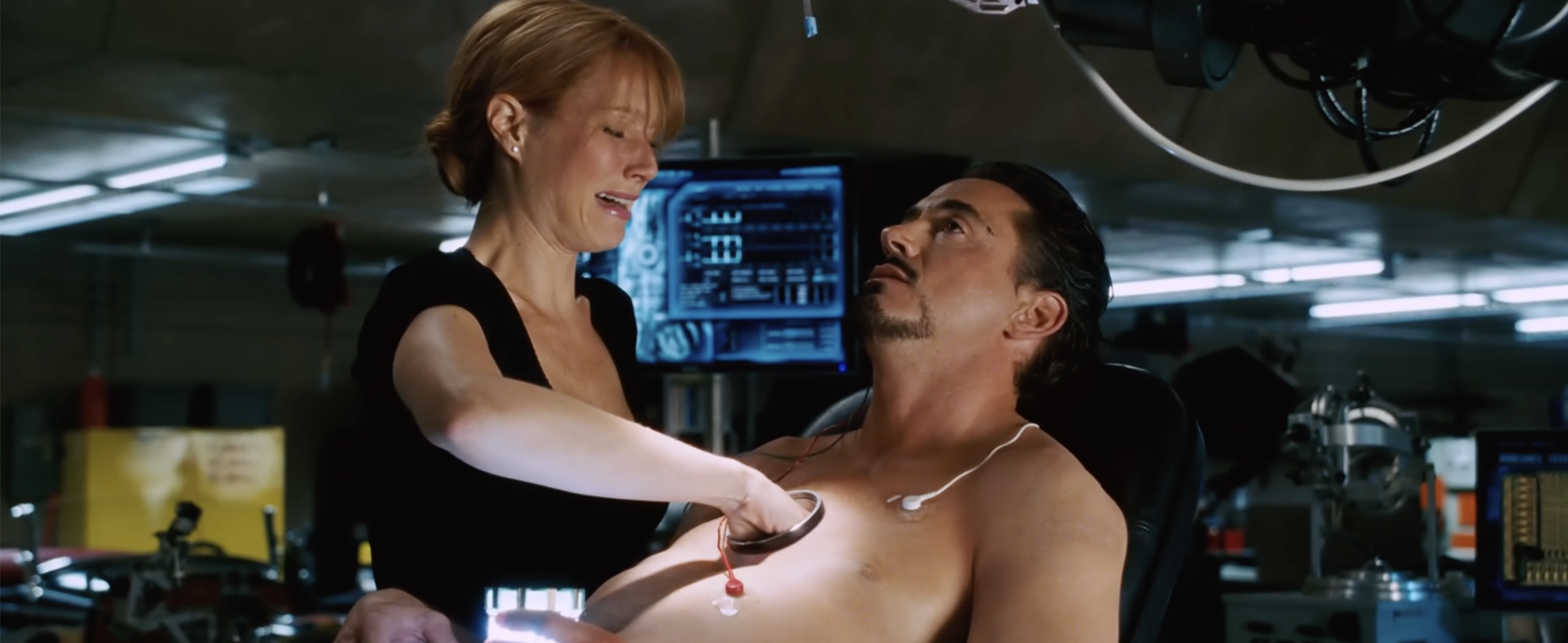
The crude magnet installed into Tony’s chest by fellow prisoner Ho Yensin (Shaun Toub) is another gnarly little bit of costume design, almost like something out of a Cronenberg film. But Tony realizes this is untenable. Using his smarts and half a dozen bomb casings, Tony is able to craft an even more powerful magnet, and one that looks like a shiny new Apple device. It works like magic, and you’re not supposed to think about it much, though the movie certainly invites it. One of the key scenes in the film finds Tony replacing the old arc reactor for an even better one, forcing Pepper to stick her hand into his chest cavity (in a vaguely sexual manner) to plug the new one in. She winds up yanking the actual electromagnet out, which you’d think would be a death sentence since, y’know, that’s the thing doing all the work here. You get juuuust enough hard science-y lookin’ stuff that the rest can be dismissed as movie magic. Yadda yadda yadda, Tony’s fine now.
The first act is this very serious, dour commentary on the War on Terror, weapons profiteering, all that stuff. So watching Tony and Yensin literally hammer together a makeshift iron suit to escape this mess is exciting. It shows the hard work and ingenuity that requires Tony to become a better person. He’s not just forging the Mark 1 suit to escape captivity. He’s doing it because he sees the sinister underbelly of the industry that made his entire life possible.
Escaping captivity, witnessing Yensin sacrifice his own life to save Tony, destroying the very weapons that made his fortune; Tony returns home a completely changed and scarred human being. (Come to think of it, Tony’s entire arc in the MCU is punctuated by one PTSD-triggering episode after another. Poor billionaire just can’t catch a break, can he?) Tony gets back stateside and immediately calls a press conference where he announces he’s shutting down Stark Industries’ weapons division, which naturally wreaks all sorts of havoc. While Stane is left managing the shareholders, Tony retreats to his man cave to lick his wounds and tinker with his new toy.
You can kind of break the film into three separate acts, each punctuated by a new Iron Man suit. Act one, naturally, culminates in the building of the Mark 1 and Tony’s escape from Afghanistan. Act two finds Tony experimenting with his design and eventually building the Iron Man suit we all know and love. The absolute highlight of the film finds Tony taking the unpolished Mark 2 for a test flight around Santa Monica. Ramin Djawadi’s score shifts into high gear at this point, and the film is never more fun that when we get to watch Tony realize he can suddenly fly. One thing I always disliked about the followup films is that it never reused Djawadi’s score, which I think is genuinely fantastic. But then Ramin Djawadi quickly pivoted to working on Game of Thrones, so he did alright for himself.
In the clip above, that’s Wimbledon‘s Paul Bettany as the voice of Tony’s AI assistant, Jarvis. It’s kind of amazing how, even from the very beginning, the greater MCU has been shaped by Jon Favreau deciding to cast his former co-stars in pivotal roles. (For her part, Gwyneth Paltrow appeared in 1994’s Mrs. Parker and the Vicious Circle with Favreau. We didn’t cover that film for this column, and I honestly couldn’t say whether that’s why she was cast.) And speaking of past co-stars, Favreau’s buddy Peter Billingsley shows up as a Stark Industries scientist who has to meekly explain to Jeff Bridges why he can’t replicate Tony’s arc reactor. (Billingsley’s character will return, as will Bettany’s.)
So then the final act, where all this shit comes to a head, reveals that it was Stane who set Tony up to be kidnapped by The Ten Rings. Even before Tony became Iron Man and announced he was tanking the company, Stane was already plotting a hostile takeover of the company himself, the bastard. The leader of the group, Raza (Faran Tahir), brings Stane the blueprints for Tony’s Mark 1 suit, allowing him to build a bigger, better, badder suit for the expressed purpose of murdering Tony. Why Stane couldn’t just kill him when he very clearly had multiple chances, is a mystery, but then this is a comic book movie, so grains of salt all over the place, right?
If the Iron Man vs. Iron Monger fight feels a little wonky to you, you’re not going crazy. This scene was the result of some desperate reshoots when Favreau finished the movie and discovered the original ending didn’t work at all. With what little money the production had left, they managed to cobble together a fight scene based on the footage they’d already shot, and with a few extra pages written literally the day before the 2007 Writer’s Guild strike. Pepper shows up with Agent Coulson (Clark Gregg) and his S.H.I.E.L.D. buddies to arrest Stane, but are completely blindsided by his giant robot suit that literally nobody knew he was building.
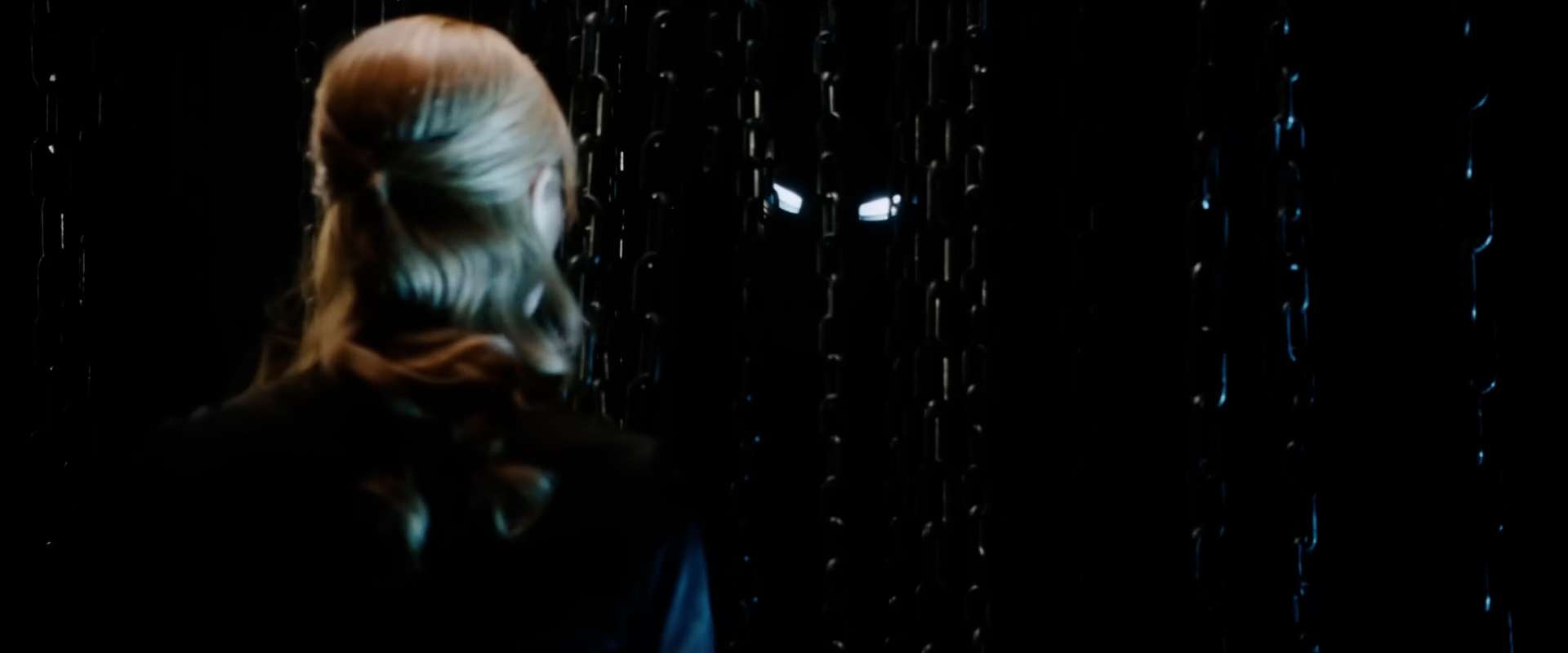
So Tony shows up half beaten to shit and ready to fight the Big Lebowski with his little robot suit, which doesn’t really go well for him. He leads Stane into the stratosphere, where the Iron Monger suit ices up and crashes back down to earth (which was part of what they figured out in reshoots), but then back on terra firma Tony has to use his wits to defeat Stane. And by “use his wits”, I of course mean “ask Pepper to press the big red button and blow up the power plant at HQ right in Stane’s face.” Bang, zoom, right to the moon.
If there’s any one thing I can complain about here, is that Iron Man kinda set the precedent that it’s okay for MCU movies to feature a villain who’s basically the evil version of the good guy. Incredible Hulk did it, and so did Captain America, Ant-Man, Doctor Strange, Black Panther, etc. At this point I just think it’s something endemic to comics more than anything else. Not for nothin’, but when Superman does “bad version of good guy”, it’s literally an evil twin from Bizarro world; not just “some asshole who stole the good guy’s idea”. But then I’m not really a comic guy, so what the hell do I know?
This piece has already gone on longer than it rightly needed to. I just felt like this was a real watershed moment in Twenty 20-Fav, and it deserved an extra-long examination. I swear to you, my Iron Man 2 piece won’t be nearly this long!
Iron Man is a game changer for a whole host of reasons. It brought Robert Downey, Jr. back to the A-list in a big, big way, and the man has genuinely relished every moment of his comeback. So much so, that he’s poised to return to the MCU next year. We’ll see how that goes, but you just know he’s counting every dump truck full of money that Kevin Feige personally backs up into his front yard. Downey’s earned it. Iron Man also brought verisimilitude back to comic book movies at a time when they desperately needed it. And it can’t be overlooked that this movie came out the same summer as The Dark Knight, featuring Heath Ledger’s Joker, who practically has the word ‘verisimilitude’ tattooed on his forehead.
And even if Dark Knight wound up beating it at the overall box office, Iron Man was still a huge hit. It was the hit Marvel needed exactly when they needed it. Making $585 million on a $130 million budget, Iron Man immediately made back the bankers’ initial investment, allowing the studio to breathe a little easier as they ramped up for their second feature, The Incredible Hulk, later that summer. Nominated for two Academy Awards (sound editing and visual effects), selected for the National Film Registry in 2022, and the birthplace of a film franchise that is still going today. Not too bad for a first try.
THE FAVREAU DIMENSION (REPRISE)
One thing I was somehow unable to fit in anywhere above is that, in addition to directing the film, Favreau cast himself as Tony Stark’s personal chauffeur, Happy Hogan. He only appears in a few scenes, not making much of an impression, but it’s a choice that will pay huge dividends down the road, and assures there’ll be a whole bunch more Marvel movies in this column’s future.
FINAL VERDICT
4 stars (out of 5). S’good.
NEXT TIME: When three Christmases simply aren’t enough…
- Avi Arad had previously been the CEO of Toy Biz before the company merged with Marvel Comics. The guy knew toys.
↩︎ - The book “MCU: The Reign of Marvel Studios” by Dave Gonzales, Gavin Edwards, and Joanna Robinson (which became my primary source for this piece) makes it sound like Marvel’s end of this deal was basically a good-faith gesture. All the contract said was that Marvel would *try* to raise their share of the money. Not that they explicitly *had* to. (But apparently they did.)
↩︎ - A real word marketing types invented in the 90s to describe characters or properties that were ideally suited to becoming mass-produced toys. In writing out that last sentence, I suddenly realized I was directly quoting a Freakazoid joke from thirty years ago.
↩︎ - Literally the first thing we hear is AC/DC’s “Back in Black”, which I always thought was a weird choice to introduce Tony Stark. Back in Black? Back from what, exactly? Save “Back in Black” for the sequel. Or at the very least when he returns home from captivity. Geez, you guys, do I have to think of everything? ↩︎

Leave a comment