

These days, it feels like we’re all in a bit of a mental health crisis. If you’re not suffering a panic attack every time you turn on the news, then you’re probably enduring sleepless nights obsessing over a litany of regrets. Show me a person claiming everything is hunky dory, and I’ll show you a damn liar. But it doesn’t have to be this way. Help is out there. We can dig ourselves out of the dumpster of our own making if we’re willing to put in the work and break ourselves down a little in the process.
That’s the idea at the heart of W.M. Weikart’s feature debut, Soul to Squeeze. It’s a film that takes us on a journey through one man’s psyche; his memories, his regrets, and the choices that threaten to crush his soul. A heavy experience? Sure, but it’s also one that’s endlessly inventive, and occasionally very funny in the way that only a truly twisted mind can be.
Right away, it’s impossible to separate the film from its title, taken from a Red Hot Chili Peppers song. That song finds its narrator reflecting on years of drug abuse and its effect on his mental well-being. “Insanity it seems,” Anthony Kiedis once sang, “Has got me by my soul to squeeze.” And while Kiedis ultimately granted himself the grace to move on from that part of his life, that’s exactly the point at which this film introduces its protagonist.
Michael Thomas Santos stars as Jacob, a young man who decides he’s finally ready and willing to confront the emotional demons inside himself. He signs up for a mysterious mental health procedure, which involves Jacob entering into a liminal space between consciousness and dreaming, where he will be forced to confront his biggest fears and worst regrets. The hope is that he’ll finally be able to move on with his life, but since this process is compressed into a single weekend of therapy, Jacob will either work through his issues or die trying. (This, as the waiver he signs suggests, is a very real possibility.)
As Jacob slips deeper into his subconscious, he encounters various characters and figures, some familiar faces from his past, while others seem to be imagined out of whole cloth. During the first evening of his ordeal, Jacob meets a man trapped in his own dreamlike fugue (Greg Baldwin). The guy explains this is a space where your physical body and subconscious mind exist together, in the same place at the same time. Not entirely understanding what this means, Jacob wakes up at the breakfast table as a game show host enters the kitchen and reminds Jacob the name of the game is “Don’t Fuck This Up!”
It makes sense that the first layer of our subconscious would be populated by pop culture figures. This game show host (Ken Belsky) bears a striking resemblance to The Price is Right host Bob Barker, right down to the pencil-thin microphone he always carried. It seems like a non-sequitur, but then most millennials have a parasocial relationship with at least one game show host from their youth. It’s a TV face that you grew up watching, a constant figure in your life, comforting you on sick days, challenging you to always do a little bit better. Those figures are important, but for Jacob, it comes off as a harbinger of things to come.
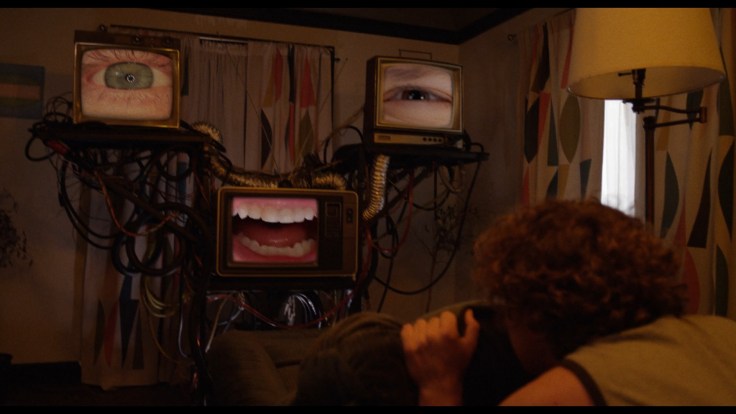
The further we descend into Jacob’s nightmare brain cleanse, the film frame itself grows progressively wider. Soul to Squeeze begins in a 4:3 aspect ratio, which is the standard found in most old-school TV programs. The frame gradually gets wider to reflect Jacob’s elastic mental state. Slowly expanding outward as he’s forced to confront past traumas and mistakes made, the film eventually expands all the way to 2.35:1. As Jacob emerges from his ordeal, we suddenly see the world as it was meant to be seen: in beautiful, glorious widescreen Cinemascope. It’s a technical trick that unfolds quietly over the film’s short runtime, but one that proves extremely effective.
There are moments during Soul to Squeeze that will test your patience. Jacob’s emotional turmoil revolves around his relationship with his childhood best friend, Shirlene (Danielle Meyer), and as that thread gradually unfolds, it’s hard not to mentally skip ahead to where we can all guess it might be headed. The way Jacob relives his past memories—sometimes as grainy old home movies, sometimes as amorphous blobs of light—is visually dazzling, though it can feel overwhelming in the moment. Still, Soul to Squeeze offers a unique, heartfelt portrait of how we process our memories, and marks a confident debut from a filmmaker worth watching.

FINAL RATING
3.5 stars (out of 5). S’pretty good. A clever, confident debut.
Soul to Squeeze is available now on Amazon Prime Video.

Leave a comment