
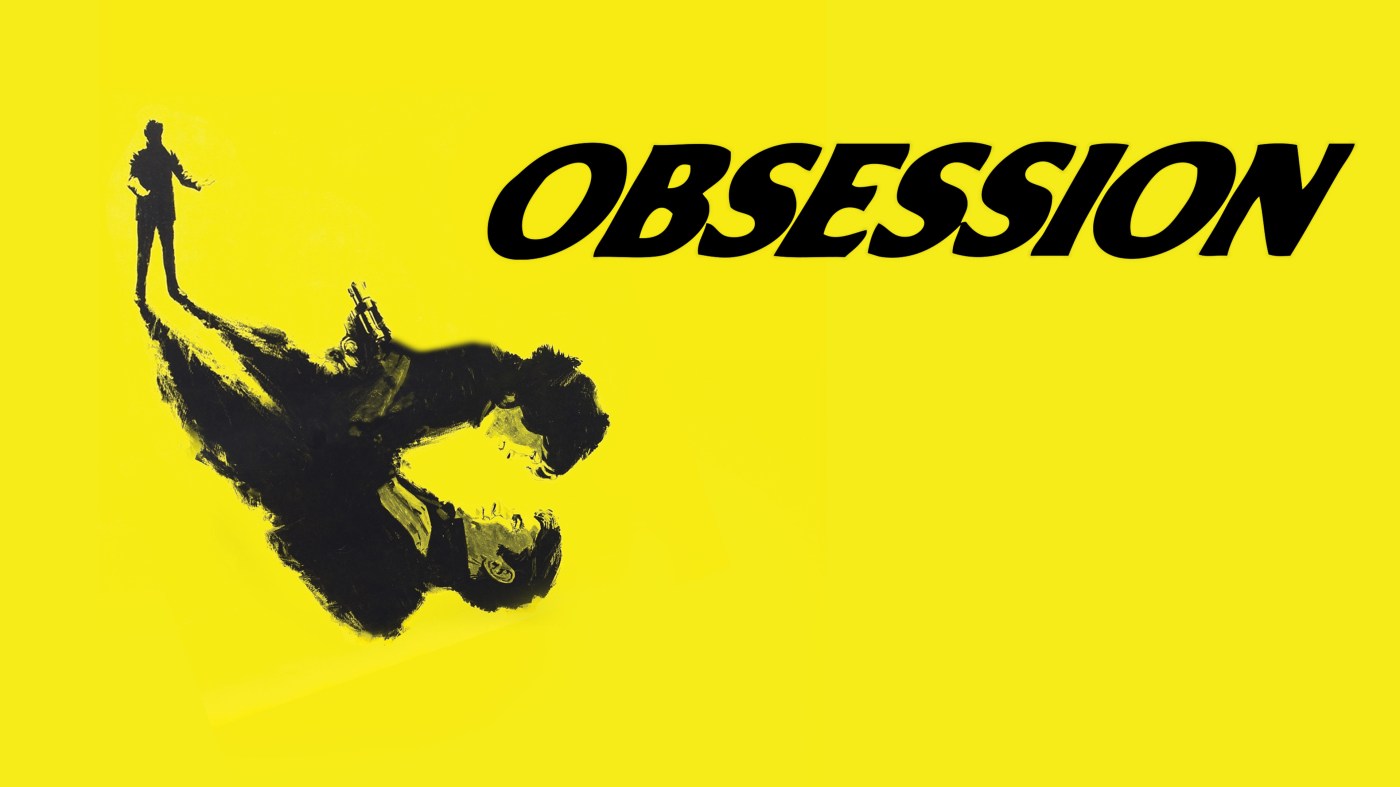
Welcome to back SchraderVision, in which I attempt to understand writer/director Paul Schrader by exploring his filmography from start to finish. In this entry, we move on to his third produced screenplay: Brian De Palma’s OBSESSION.
The last piece in this column took me four years to write and publish. Let’s see if we can knock this one out a little quicker.
It’s no secret that Paul Schrader has always been a bit of a blind spot in my cinematic education—Hell, it’s what this column is all about—but Brian De Palma isn’t far behind. So forgive any ignorance of De Palma’s style or personal peccadillos. It’s really not what we’re focusing on here. Anywho, around the same time Schrader was working with Martin Scorsese on Taxi Driver, he was also collaborating with De Palma on his follow-up screenplay, Obsession1.
As Obsession opens, we meet New Orleans real estate magnate Michael Courtland (Cliff Robertson), who is happily married to his wife Elizabeth (Geneviève Bujold). One night after a lavish dinner party with his business partner Robert (John Lithgow), Elizabeth and their daughter Amy are kidnapped at gunpoint and ransomed for half a million dollars. Michael tries to cheat the kidnappers out of the money, resulting in a car chase that leaves Elizabeth and Amy both dead.
Sixteen years pass, and Robert takes Michael to Florence, Italy on a business trip. While in Florence, Michael visits the church where he first met his wife. There, he meets a young woman named Sandra, who bears an uncanny resemblance to Elizabeth (she’s also Geneviève Bujold). It doesn’t take long for Michael to become infatuated with this woman, the spitting image of his late wife, and he somehow talks her into coming back to the States with him to be married. She tells him she’s a good Catholic girl, and must save the fun stuff for their wedding night. (As it turns out, this bit is crucial). As Michael and Sandra get to know one another, Michael starts unconsciously grooming Sandra to look and act the way he remembered Elizabeth, right down to the way she would walk up a flight of stairs.
[IF YOU SUDDENLY FEEL COMPELLED TO WATCH THIS, HERE’S YOUR SPOILER ALERT.]
Just as Sandra bears an uncanny resemblance to Elizabeth, Obsession‘s pieces start falling into place and begin to resemble Alfred Hitchcock’s Vertigo. This is no great insight on my part; it was more or less De Palma and Schrader’s stated objective. De Palma, the world’s foremost expert on ripping off Hitchcock, had his work cut out for him, treating the film as a formal exercise in aping Hitchcock’s style, right down to the camera moves and urban tableaus (swapping out San Francisco for New Orleans).
And since this is a riff on Vertigo, if you guessed that Sandra and Elizabeth were one in the same? Well, you’d only be half right. Just before their wedding day, Michael wakes up to discover that Sandra has also been kidnapped (the same exact ransom note from 16 years prior shows up in her bedroom). And after Michael makes another phony handoff, it’s revealed that the culprits of this entire thing are, in fact, Robert and Sandra. And because one twist isn’t enough, Sandra is revealed to be Michael’s daughter Amy all grown up (yeeeesh…). This isn’t where the film ends, and I’m only ending the summary here because I’m frankly tired of this nonsense.
When Obsession works, it’s plenty engaging; it’s just that those moments are mired in a lot of melodramatic nonsense. In fact, if we can get into what the film does right for a moment, a big part of all this is cinematographer Vilmos Zsigmond. The way he shoots New Orleans and Old Florence with this lush, soft focus—a romanticism that visualizes the way Michael sees Elizabeth and Sandra in his own mind—really does a lot of the heavy lifting in aping Hitchcock’s style. Zsigmond shot this film in between two Spielberg films (Sugarland Express and Close Encounters, the latter of which won him an Oscar), and boy does it show. If absolutely nothing else, Obsession is a beautiful piece of work.
The other notch in the film’s ‘win’ category is the score from Bernard Herrmann, himself a frequent collaborator of Alfred Hitchcock’s, and who actually composed the score for Vertigo. His music for Obsession is equally lush and dramatic, the sweeping strings once again informing Michael’s particular brand of psychosis. This would be one of Herrmann’s last compositions before his death in 1975 (the very last film he composed for was Taxi Driver, as it turns out). Hermann personally considered this the finest score he ever composed. It’s nice to know that the man genuinely thought he went out on top; he absolutely did.
Paul Schrader, for his part, was more interested in exploring Michael’s sense of guilt and duty than in pulling off any kind of Hitchcock pastiche. After the car crash that claims his family’s lives, Michael takes the plot of land he had intended to develop and instead erects a giant monument to his wife and daughter’s memory. That monument, incidentally, is a replica of the facade to San Miniato al Monte in Florence, the very church he first met his wife, and where he’ll soon meet Sandra. Even before he ever meets Sandra, Michael is obsessed with his own memory of Elizabeth, much in the same way that Jimmy Stewart becomes obsessed with Kim Novak in Vertigo. The only problem with all of this is that Cliff Robertson is stiff as a board, and the least charismatic leading man they could have possibly chosen.

Schrader and De Palma had a falling out during production, as it was determined that Schrader’s third act didn’t work at all. (Bernard Herrmann suggested as much during pre-production). In Schrader’s original draft, titled Deja Vu, the story continues long after the film’s resolution, where Michael and Sandra have to play out a third kidnapping scenario ten years later. “My original idea in the script was to write an obsessive love [which] transcended the normal strictures of time,” Schrader explained. I’m gonna side with De Palma and Herrmann on this one and say that hacking this story down was the right call. At 98 minutes, it’s tolerable. Bizarre and circuitous, but tolerable. Adding a whole extra postscript, with what sounds like another half hour of material, would have made Obsession interminable.
I guess the last thing worth mentioning here is that taking the Vertigo plot and adding the extra little twist of Sandra being secretly Michael’s daughter makes Obsession a stealth forerunner of Park Chan Wook’s Oldboy. That film really doesn’t have much in common with Hitchcock’s film, but the whole “business creep using his partner’s daughter to play out a decade’s long revenge plot” is too close to ignore.
And while I can’t say I’ll ever want to watch Obsession again, it makes for a fascinating game of cinematic telephone. What began as the novel “The Living and the Dead” by Boileau & Narcejac (1954) then became Alfred Hitchcock’s iconic Vertigo (1958), later paid homage by De Palma and Schrader in Obsession (1976), itself reworked into Park Chan-wook’s Oldboy (2003) and finally remade as Spike Lee’s Oldboy (2013). Not too shabby.
FINAL RATING
3 stars (out of 5). S’fine. I mean, it’s no Vertigo.

Leave a comment