
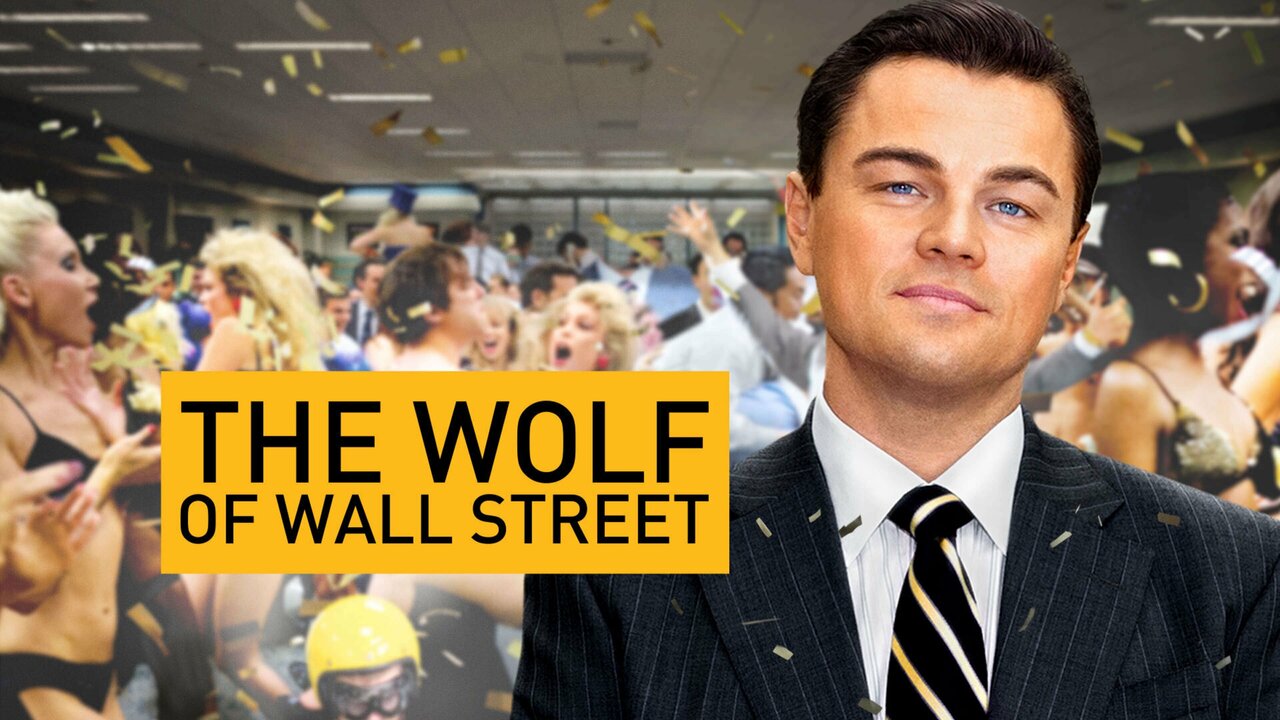
In Twenty 20-Fav, we’re spending 2025 examining the work of actor/director Jon Favreau. This week Martin Scorsese comes calling as we look at The Wolf of Wall Street.
The 2010s saw a handful of biopics that, in hindsight, all seemed to depict the same thing: The Slow and Inexorable Ruin of Modern America. Aaron Sorkin’s The Social Network detailed the rise of Facebook and the sociopathy that made Mark Zuckerberg a billionaire; Bennett Miller’s Moneyball chronicled Oakland A’s coach Billy Beane and how his use of sabremetrics turned Major League Baseball into a numbers racket that nobody cares about anymore; Adam McKay’s The Big Short recounts the events leading up to the 2008 financial crisis and the assholes who stood to gain the most from it.
Right in the middle of all that, and perhaps most emblematic of the entire trend, came Martin Scorsese’s The Wolf of Wall Street. Based on the tell-all memoir of former stockbroker Jordan Belfort, the film illustrates how he and his crew bilked investors for millions upon millions of dollars, did all the drugs, banged all the chicks, and basically got their revenge on the 80s for daring to come to an end. It’s a film that rightly paints the excesses of the Wall Street crowd as brazen and inexcusable. It also refuses to shy away from any of it, reveling in the money-fueled debauchery and drug-addled orgies that surely must have happened somewhere at some point. For three uninterrupted hours, Scorsese rubs our noses in the sheer money-grubbing indulgence of Belfort’s lifestyle, asking us to hoot and holler at the absurdity of it, while also reminding us that this is how the 1% actually behaves, doing anything and everything to stay above the law. That’s the movie’s defining feature, and also, ultimately, where it loses me.
Leonardo DiCaprio stars as Jordan Belfort, a wannabe stockbroker who has the extreme misfortune of landing his first gig on Wall Street the day of the Black Monday stock market crash of 1987. A little career advice from Matthew McConaughey and an answered classified ad later, Belfort finds himself pushing penny stocks to randos over the phone. The details of all this are breezed over pretty quickly–occasionally by DiCaprio himself, who looks us dead in the eye and assumes we have no idea what he’s talking about–but the long and short of it is this: Belfort receives a 50% commission on all penny stocks he sells, so he works up a bullshit PR script, rounds up a few of his work buddies (including Jonah Hill in a truly wacked out performance) and starts his own firm to fleece as many rubes as humanly possible.
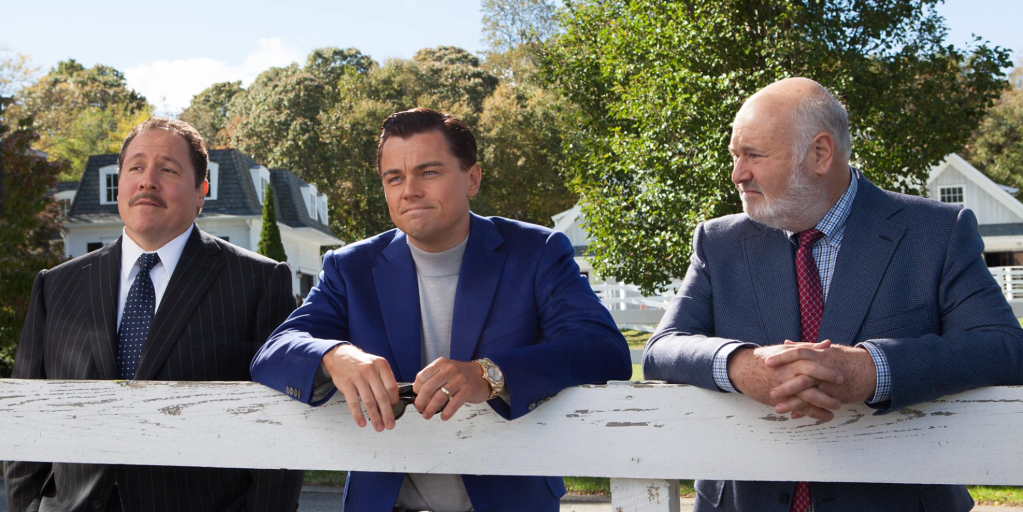
This turns out so insanely lucrative so quickly that not only does Forbes magazine run a hit piece on him outlining how reckless his business practices are, but the resulting publicity brings in dozens of new hires who all want in on the grift. This pushes Belfort’s ego and his business to even more ridiculous heights. He brings in his dad (Rob Reiner) to manage the company expenses, hires a lawyer (Jon Favreau) to keep the SEC off his back, and openly cavorts with blonde bombshell Naomi (Margot Robbie) despite already being married (to Cristin Milioti). At one point he flat out tells us that his drug of choice is quaaludes and, being a hyper-rich Wall Street asshole, he has connections for acquiring them even though quaaludes were taken off the market in 1985.
And while we’re in the midst of this whirlwind and riding high on the sheer glee that these idiots throw themselves at their jobs, it’s a fun movie. The utter contempt that these guys have for their clients, their competition, and basically anyone who isn’t them is weirdly infectious. Belfort surrounds himself with clowns who know how to read a script, but who don’t necessarily have the best business sense of their own. One of the highlights of this idiot brigade if Belfort’s low-level drug pushing buddy Brad (Jon Bernthal), who doesn’t necessarily go in for all the stock market mumbo jumbo, but knows exactly how to launder cash. This comes in handy later on, when our guys get paid a visit by the FBI (Kyle Chandler, who’s so good at acting like he wants absolutely no part of any of this), and Belfort realizes they need to start offloading all their money before the feds get their grubby little hands on it.
The movie’s plot, such as it is, is honestly a pretty simple one: Guy gets rich through dubious means, guy tries to skirt the law to keep his nut, guy’s life falls apart when he inevitably fails in his endeavor. It’s basically the entire plot of Breaking Bad, minus all the western tropes and health insurance commentary. It also, like Breaking Bad, goes on for far, faaaaar longer than it rightly should.
The first hour or so of Wolf of Wall Street plays out like the opening montage of Goodfellas in its ultimate, most outlandish form. We’re introduced to Belfort, told that as far back as he could remember, he always wanted to wipe his ass with hundred-dollar bills, and see how quickly he ascended to the echelon where that became a legit possibility. Scorsese directs this movie with a ferocity that, at the time, seemed to suggest this might be his last hurrah. The way he puts us right in the thick of things, it’s almost like he’s saying “You motherfuckers took all the wrong lessons from Wall Street, didn’t you?” But it needed to be this brazen. It needed that piss and vinegar approach, because Jordan Belfort’s life’s work is a fucking outrage. It’s reprehensible by every stretch of the imagination, and Scorsese realizes that this is the only way we’re going to get the message.
Problem is… I got the message about an hour into the movie. And the movie persists. One house party leads to another, which leads to another drug-fueled orgy, which leads to businessmen hurling little people at a velcro dartboard, which leads to naked marching bands stomping around the office, which leads to raves, and so on, and so forth… Okay, Marty, I fuckin’ get it. Money bad. Money very bad.
Fun fact: I reviewed this film twelve years ago, and I truly can’t say my opinion on it has changed a whole lot. I said everything I’m saying here in a more eloquent, compact little review. I even remember at the time being chided for thinking the excess was too much. “Scorsese is a national treasure! There’s no such thing as too much of a good thing!” Someone actually said this to me without a shred of irony, like the movie doesn’t literally spend three hours saying the exact opposite.
Watching it again twelve years later, what’s apparent to me now is how perfectly orchestrated everything is. This film moves like a freight train. It doesn’t take long to reach its full speed, and once it gets there, this thing ain’t gonna stop. But when it does finally stop? Man, that shit ain’t pretty. Scorsese keeps this thing moving like a well-oiled machine, and DiCaprio is the perfect ringleader. Building on his earlier work as bullshit artist Frank Abagnale in Catch Me If You Can–and in the same year that he portrayed literature’s favorite millionaire playboy Jay Gatsby, no less–DiCaprio has perfected the art of the sociopath. You look into Belfort’s eyes and see not a shred of humanity, just the insatiable wolf who knows he can’t stop himself and instead leans right into it.
Jonah Hill and Margot Robbie are both equally great in this as well. Hill, with his hair piled high like Cosmo Kramer and his teeth whitened to the point of absurdity, is just the image of mundane 80s excess. His Donnie is a guy who sees the self-made man Jordan Belfort is and wants that for himself so badly he can taste it. He gives this nasally, bug-eyed performance, wrapped in a bullshit cardigan sweater and he almost seems like a cartoon character. It’s some great work.
Robbie, on the other hand, was a movie star from the moment she stepped onscreen. And everyone else in the movie knows it. But, because this movie is packed to the gills with scumbags and creeps, the first thing we hear as she enters the scene is someone off-camera saying, “I’d let her give me AIDS.” Just the kind of boneheaded, embarrassing one-liner you’d expect from a drugged-up rich kid, and all I can say about that is I’m glad Margot Robbie was able to rise above it. She realizes, like Scorsese does, how these guys are looking at her, and she comes back at them with as much bile and spite as she can muster. She’s a goddamn tornado in the middle of this movie, able to throw Belfort’s bullshit right back into his face, and it’s little wonder Robbie became a star because of it.
I can sit here all day and talk about all the little things I do enjoy about this movie, because I can still recognize the craft and the punk rock attitude that went into it. I can also appreciate the fact that someone at Paramount said “this very well might be Scorsese’s last movie, so let’s give him $100 million and let him go HAM”. But with the benefit of hindsight, I know Scorsese’s made three movies since Wolf of Wall Street1, so I’m not feeling as precious about this one as I maybe once did. I don’t feel as bad about not fully appreciating this in its time anymore. So my earlier assessment still stands: While I can appreciate the movie for what it is, the excess is ultimately what kills it for me. I get it. I See What You Did There. But I just don’t need that shit.
THE FAVREAU DIMENSION
Once again, Favreau is on hand for two scenes, this time playing Belfort’s lawyer Manny Riskin. He doesn’t get much to do here; just one of the laundry list of actors who obviously jumped at the chance to do a scene for Scorsese. Favreau’s sporting a pencil-thin mustache, which honestly makes him look a little bit like Walt Disney. I can appreciate this because very soon we’ll be spending a lot of time in the Disney ecosystem.
FINAL RATING
3 stars (out of 5). S’fine, I guess. Coulda been great, though.
NEXT TIME: Order up.
- Silence, The Irishman, and Killers of the Flower Moon. Two of these movies are so, so much better than The Wolf of Wall Street. ↩︎

Leave a comment