
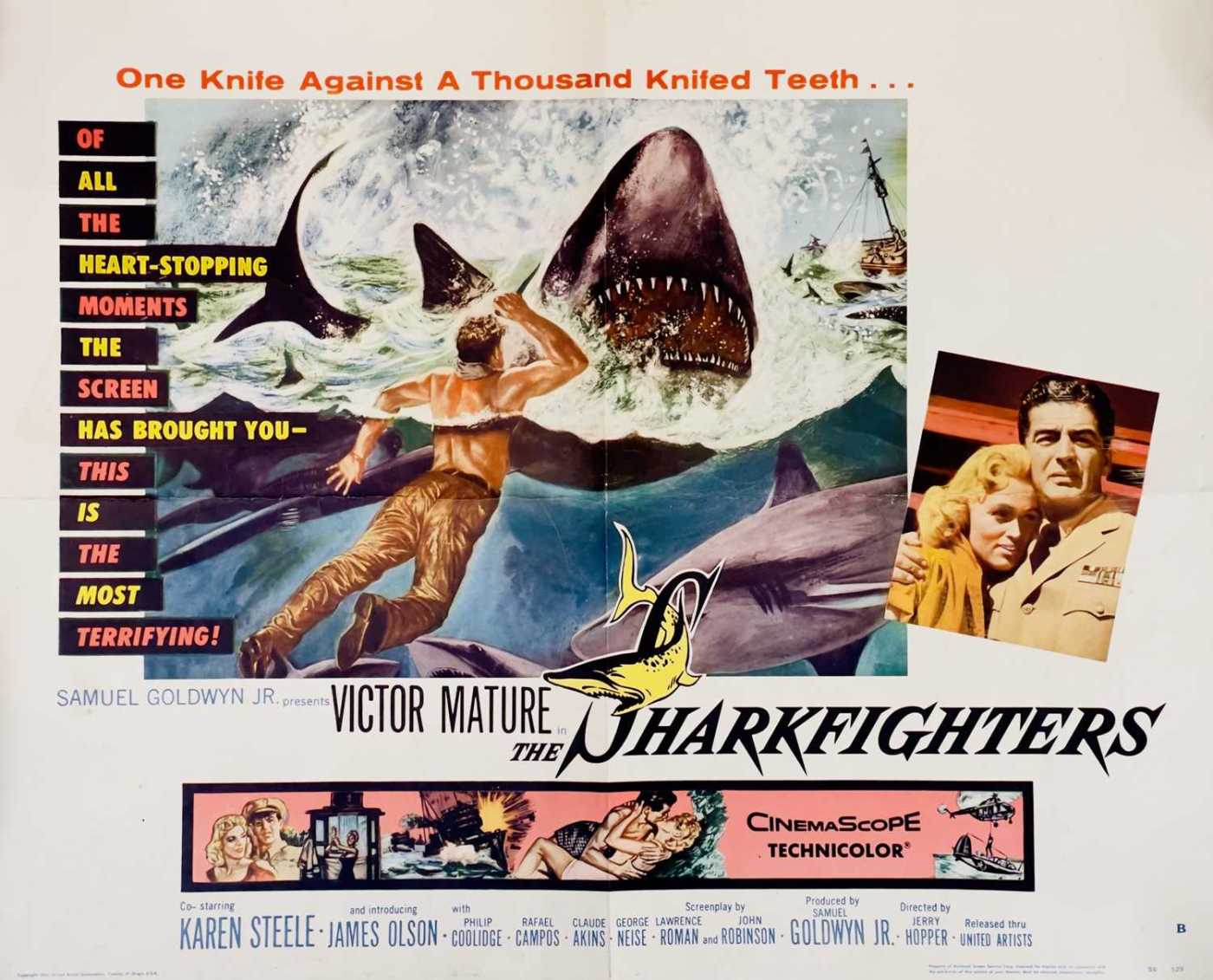
Twenty 20-Sharks is a chronological survey of shark attack movies. We begin this disaster with the invention of shark repellent in The Sharkfighters.
Our survey of shark attack movies has to begin somewhere, and as we mentioned in our intro piece, 1956’s The Sharkfighters seems the most logical candidate. It features a few key hallmarks of the genre that we’re going to be seeing over and over again moving forward: Scientists interacting with sharks for research purposes; poor souls meeting a grisly fate in the jaws of an aquatic killer; men going head to head against sharks to prove their worth in conquering nature. All of this wrapped up in a concise, 73-minute package makes The Sharkfighters a perfect launching point for this series.
When you hear the phrase ‘shark repellent’, the first thing you’re probably thinking is from the 1966 Batman movie, where Adam West uses a canister labeled “Bat Spray Shark Repellent” to repel a pesky shark. But what most comic book nerds today might not realize is that shark repellent is a very real technology dating back to World War II1. Pilots and sailors serving in the Pacific Theatre stood a nonzero chance of finding themselves stranded in open water, with man-eating sharks lurking just beneath the surface.
This is where The Sharkfighters comes in; the whole movie revolves around the US Navy developing a viable shark repellent in case any wayward sailors find themselves going overboard. Now I’m not going to sit here and pretend I know anything at all about shark repellent, or even marine chemistry in general, but the fact this movie tries to depict the scientific development process—the trials, the errors, the whole scientific method—is admirable. It’s boring as hell, but admirable just the same.
Victor Mature stars as Lt. Commander Ben Staves, sent down to Cuba to oversee the final phases of development in 1943. We find out that Staves has been reassigned after his boat went down in the Pacific, and that he spent nearly two weeks adrift at sea as sharks picked off his fellow sailors one by one. (This is an oblique reference to the sinking of the USS Indianapolis, which happened in July of 1945.2)
In Cuba, Staves meets Lt. Commander Evans (Philip Coolidge), who’s been leading the study for the past six months, and his assistant, Ensign Duncan (James Olson). We also meet a teenage deckhand named Carlos (Rafael Campos), who gets too excited after one of the crew’s repellent solutions actually works and falls overboard like an idiot.
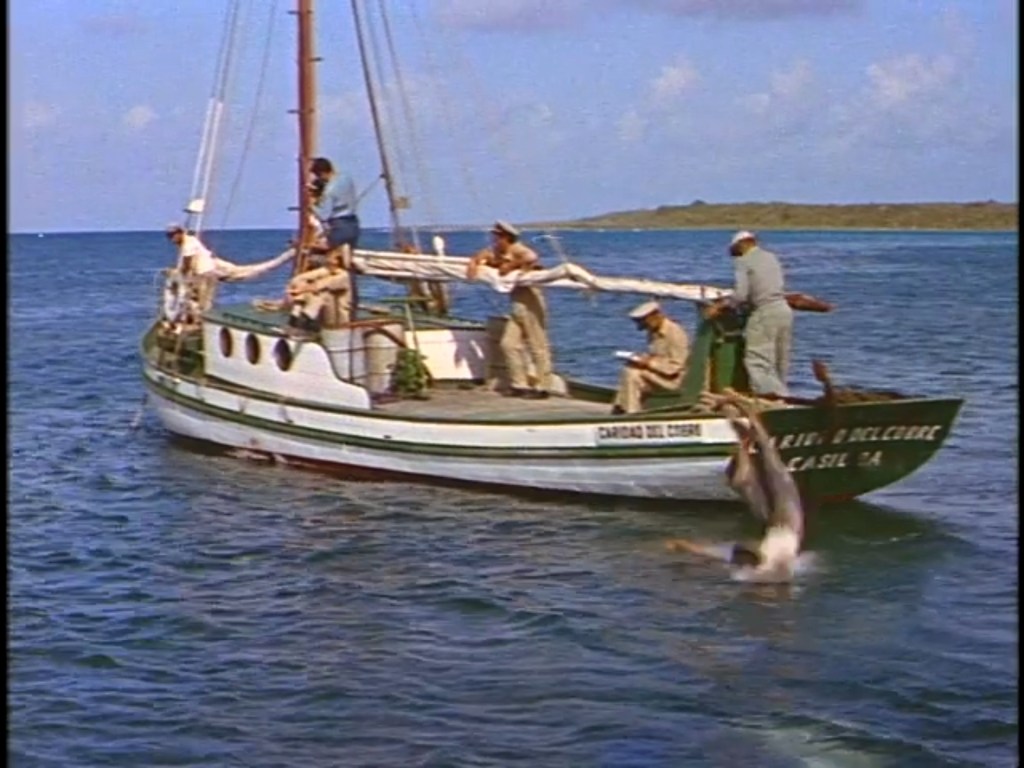
Instead of immediately throwing Carlos a life preserver and simply pulling him in, Staves tells him to swim away from the boat and into the experimental shark repellent. Even though the repellent actually kinda works, Carlos is attacked and killed before he can be pulled from the water. (It’s later revealed that Carlos died because he panicked and stabbed a shark in the water, causing the other sharks to go into a feeding frenzy.)
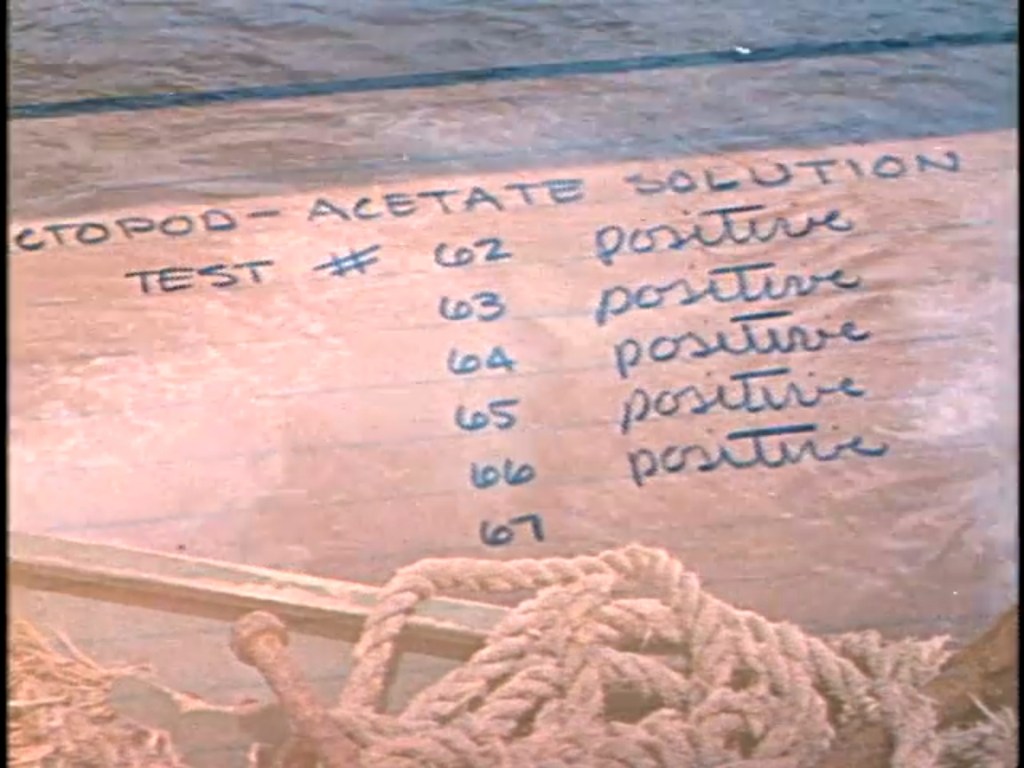
After Carlos’ funeral, Staves is emboldened to get this shark repellent right, and in order to do that, he decides the only way is to test it out on actual live humans. Cue montages of men doing science, including a scene where Duncan goes scuba diving along the reefs and catches a live octopus with his bare hands. We also see Evans conducting all sorts of chemical tests to bind octopus ink with copper acetate, and the accompanying paper trail showing his work.
Staves gets a brief sketch of a character arc, forcing him to overcome his fears. Having survived a shipwreck where shark attacks were frequent, Staves has understandably developed a fear of sharks. We see him swimming with his wife down on the beach, and when a submerged palm frond brushes his side, Staves goes into panic mode and hurries back to shore. This fear, combined with his guilt over Carlos’ death, leads Staves to the conclusion that he needs to be the human guinea pig for Evans’ latest shark repellent solution, thus proving to himself that he can conquer his own fears, and somehow also avenge Carlos.
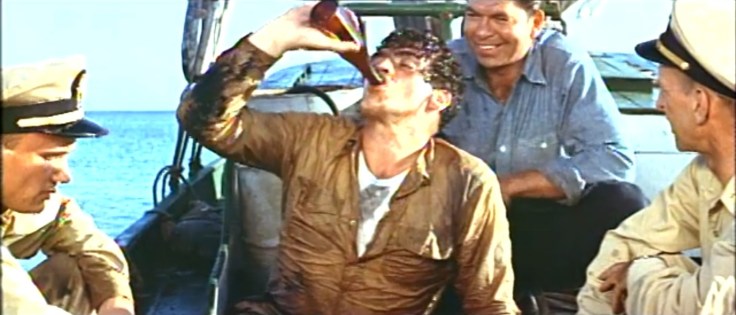
And prove it he does in the film’s big climactic moment, where he dons a life jacket and swims out into shark-infested waters armed with nothing but a knife and two military snipers. There’s a lot of quick cutting in this sequence, likely to hide the fact that Victor Mature isn’t actually swimming with two tiger sharks. But then again, there are a handful of wide shots that definitely show an actor in the water with two live sharks, and in 1956 I really doubt they had the technology to make an animatronic shark look that good, much less two at the same time. According to Wikipedia, the actor went on record about not enjoying his action scenes, so maybe he actually did do some of his own stunts, after all. If that’s the case, then he certainly earned that beer he enjoys as the credits roll.
The Sharkfighters is no great shakes, to be perfectly honest. Coming in at a brisk 73 minutes, there are only a couple scenes in which we encounter any sharks at all. It’s really only worth seeking out if you wanna watch people do science on a boat. Or if you wanna take in the sights and sounds of Cuba in the midst of their revolution. The Sharkfighters was filmed on the Isle of Pines3, just south of the main island, giving us a bit of local flavor here and there, including a couple of perfunctory dance numbers whenever our sailors cross the bay to Havana for some downtime.
It’s a neat time capsule, if nothing else. As a starting point for our survey of shark attack movies, it’s kinda rote, but it at least establishes sharks as a credible threat. There is something inherently compelling about watching a man float like a sitting duck while two tiger sharks swirl around him in open water. You just can’t fake that.
NB: There’s a reason why my screenshots are two different sizes. When I watched The Sharkfighters for this piece, I did so via MGM+, which was the only streaming service that carried it at the time. It was a pretty lousy fullscreen DVD scan of the movie, but better than nothing. As of this writing (a couple weeks later), The Sharkfighters is now available on Amazon Prime, and the print is an even worse DVD scan, this time widescreen and letterboxed. We work with what they give us.
FINAL RATING
2 stars (out of five). One star for each shark.
NEXT TIME: Sam Fuller’s Shark (1969)
- Fun fact: One of the people instrumental in actually developing this technology was future celebrity chef Julia Child.
↩︎ - And was also immortalized by Captain Quint in Jaws.
↩︎ - Later renamed Isla de la Juventud in 1978. ↩︎

Leave a comment