
Twenty 20-Sharks is a chronological survey of shark attack movies. In this entry, we discuss a documentary about sharks, the first to ever film a great white shark in its natural habitat.
In 1969 Peter Gimbel—professional adventurer and heir to the Gimbel’s department store fortune1—chartered a boat to sail the southern seas in search of a great white shark. Great whites had been known for ages as some of the most vicious killers in the ocean, but too few had been photographed in their natural habitat. That’s what Gimbel and his team of scuba divers and underwater photographers set out to accomplish when they made Blue Water, White Death.
Now, the only reason we’re covering this film in our survey at all is that it was instrumental not only in the production of Steven Spielberg’s iconic Jaws, but the thread goes back even further, helping directly inspire the novel upon which it was based.
When Peter Benchley originally pitched the idea for “Jaws” to book publishers, he was armed with a relative amateur’s background in marine biology. His primary point of reference for great white sharks was, in fact, Blue Water, White Death. That limited knowledge, not to mention a healthy interest in scuba diving and summering in Long Island, was enough to convince publishers he was any kind of expert when it came to sharks and how a coastal community might react if one took up residence offshore.
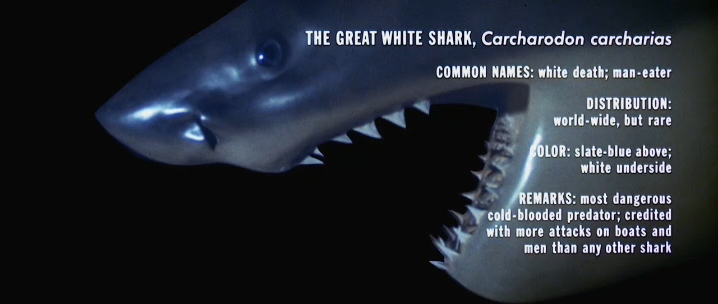
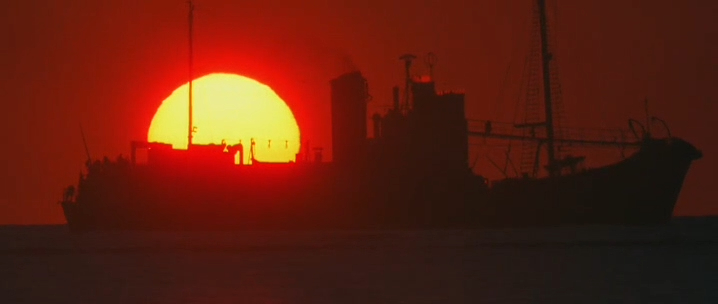
The film opens in Durban, on the eastern coast of South Africa. Gimbel and his team set out to find and photograph a great white in the wild. In order to attract sharks, they tag along behind a whaling vessel, watching as the crew harpoons a sperm whale. This, naturally, draws a feeding frenzy of sharks to the free lunch, but not a single great white among them.
It should go without saying that this is not a film for the faint of heart. Watching the whalers harpoon and kill a sperm whale is deeply unpleasant, though to the film’s credit, they at least follow through and illustrate the entire commercial process. We see the carcass hauled into port, loaded onto a train and then transported inland for butchering. This was just after commercial whaling reached its peak in the mid-60s2, and the filmmakers had no qualms about documenting it. Today, that footage is genuinely upsetting.
After a couple of days, Gimbel and his crew shove off with nothing to show for their efforts except tons of great footage of a wide variety of sharks and scenic vistas, but not the specific shark they’ve been hunting. They move on from South Africa to Madagascar, where they capture some striking close-ups of barracudas and rays, but still no great whites. Moving on to Sri Lanka, the crew once again comes up short.
The middle portion of this film certainly drags, but at this point it becomes a case of the journey being more important than the destination. Had they found their elusive great white right off the bat, this would have become a very different—and probably much shorter—documentary. We wouldn’t have scenes like the one where our crew encounters a baby seal sleeping on the rocks, startling it awake and scaring it half to death because they just can’t leave well enough alone.
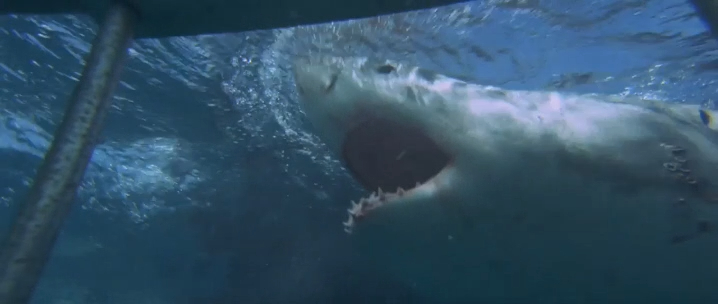
Eventually, though, we arrive off the coast of southern Australia, and all the movie’s patient waiting finally pays off. Here, the team encounters a trio of great white sharks. With the aid of a sacrificial horse and a pair of diving cages, it’s time to stage our scene. Peter Gimbel helped design and build these cages for this shoot, even receiving a patent for the buoyancy system.
Two of the underwater photographers on this expedition were Ron and Valerie Taylor. Their work in this film caught the attention of Steven Spielberg, who eventually hired the couple to help shoot the underwater sequences in Jaws. Spielberg was especially taken with a moment near the end of Blue Water, White Death, in which a great white shark becomes entangled in the cables of a diving cage and thrashes wildly in an attempt to break free. That little bit of chaos—a wild animal’s natural reaction to humans interfering in their habitat—is exactly the kind of raw, anarchic energy that makes sharks so compelling on film. It’s what Spielberg needed to help sell his mechanical behemoth as a credible monster, and it’s what Peter Gimbel knew he was after during his six-month voyage at sea.
Blue Water, White Death is very much a product of its time, described by some as the shark enthusiast’s equivalent to the surfing documentary The Endless Summer. It’s the cornerstone upon which the Discovery Channel built decades of “Shark Week” programming. It’s also an essential building block in our survey of shark cinema. We simply wouldn’t have Jaws in any of its forms without it.
Though, having said that, I also must recognize that most of this film is pretty dull. The payoff is grand, but I’m not entirely convinced it’s worth the long, tedious journey it takes to get us there.
FINAL RATING
2.5 stars (out of five). Not bad. Not great, not enough great white. But not bad.
NEXT TIME: Mako: The Jaws of Death (1976)
- Made famous more recently as the backdrop of Jon Favreau’s Elf.
↩︎ - A fact I actually had to look up for myself to make sure this wasn’t some weird aberration. See? We’re learning things together here! ↩︎

Leave a comment