
Twenty 20-Sharks is a chronological survey of shark attack movies. In this entry, we look at Universal’s actual attempt to cash in on the Jaws phenomenon: Jaws 2.
Quint was dead. The shark was dead. Amity was saved. What else was there to do?
Well, when your movie becomes a generational hit and literally changes the game for everyone, you’d be crazy not to try it again. That’s what the heads of Universal Studios said when they jumped straight into planning a sequel to Jaws.
PRELUDE
Another Jaws was guaranteed to be a hit, and producers all wanted a piece of the pie. The director and principal cast were less than enthused. Steven Spielberg passed on the project, claiming a sequel would be little more than a carny trick. Once Spielberg passed, Richard Dreyfuss followed suit, refusing to do a sequel without him. Roy Scheider wanted nothing to do with it, but after quitting The Deer Hunter right before production started, he was in no position to turn the studio down, so he reluctantly agreed to return as Chief Brody.
But then who would direct Jaws 2? The studio tapped John D. Hancock, then mostly known for directing smaller dramas and horror films (among them the cult classic Let’s Scare Jessica to Death1). Hancock’s approach to the material turned out to be too downbeat for what the studio had in mind, so after a month of filming Hancock was fired.
The production shut down for several weeks to retool, during which time producers reached out to Spielberg, who at the time was deep into production on Close Encounters of the Third Kind with Richard Dreyfuss. Spielberg considered returning to direct, even going so far as to write up a treatment, however the producers refused to wait around for him to finish Close Encounters, and moved on with a new director, French filmmaker Jeannot Szwarc. Szwarc was a known quantity to Universal, having directed several episodes of Rod Serling’s “Night Gallery” (which, incidentally, was also where Spielberg got his first big break.)
Jeannot Szwarc was a journeyman’s journeyman, having had plenty of experience working in television and film up to this point. What I mean is that the man was hired to deliver the exact film Universal Studios wanted: a sequel to their biggest hit ever that looked and felt as much like the original as humanly possible.
To achieve this, they brought back as much of the production team as possible. John Williams returned to score the sequel, layering in his original, Oscar-winning music with newer motifs and a more playful tone. (Frankly, it’s the best part of the film.) The prop department went back to work and used the original shark mold to create three new models to use during production. adventure photographers Ron and Valerie Taylor also returned to shoot footage of live sharks to cut into the film. If they couldn’t get Spielberg back, they could damn sure pretend like they did.
Production on Jaws 2 resumed with Szwarc at the helm, and it seemed that everything that could go wrong eventually did. His lead actor, Roy Scheider, actively resented having to be there in the first place, occasionally butting heads with the director over feeling like an afterthought on such a large project. The mechanical shark once again had a habit of breaking down, a result of the ocean water frequently damaging the mechanism. And with Szwarc on board, the whole production picked up and moved out of Martha’s Vineyard for the Florida coast. All in all, Jaws 2 wound up costing $30 million, three times more than the original, making it the most expensive film Universal had made at that point.
OKAY, THAT’S NICE. BUT IS JAWS 2 ANY GOOD?
Eh. It’s fine, I guess.
Seriously, though. By the late 1970s, the slasher genre was well underway with films like Black Christmas, Halloween, and The Texas Chain Saw Massacre. Jaws played a small part in that; the first half of the film isn’t all that dissimilar from Black Christmas. But what set it apart from the other horror films of the era was the second half, the adventure angle of three men setting out to stop the killer shark from terrorizing their community. That’s what put butts in the seats, but that was impossible to replicate. Quint was dead. Hooper was AWOL. That left Chief Brody all by himself to protect Amity from another killer shark.
And that right there should have given everyone pause. How exactly do we justify doing this again? The film’s tagline summed it up best: “Just when you thought it was safe to go back in the water…” It’s a great hook, just planting that simple little seed of fear that there are more sharks in the water2. But then you step back a bit and think to yourself, “Wait, so it happened again?”
Yes. The entire premise of Jaws 2 is “Somehow, they let it happen again.”
The film picks up four whole years after the original. Martin Brody (Roy Scheider) is still the chief of police. Larry Vaughn (Murray Hamilton) is, believe it or not, still the mayor. And there is another killer shark on the loose, just in time for Amity to celebrate the grand opening of its brand new beachfront resort. The first sign of trouble occurs right after the opening credits, as two divers are eaten while posing for a photo next to the sunken remains of the Orca. Not long after that, the shark takes out a pair of boaters, guilty of nothing more than trying to go water skiing. This kill is truly spectacular, as the shark eats the girl on skis, and then crashes into the boat. The second girl panics and dumps gasoline all over herself in an attempt to douse the shark. The resulting fireball is outlandish, and leaves the shark with a gnarly facial scar for the rest of the movie.
So Brody starts sounding the alarms, much to the chagrin of the mayor and town council, who are none too keen on closing the beaches with new tourist dollars rolling in. It’s the exact same setup as the first film, only this time Brody knows exactly what he’s dealing with. A killer whale washes ashore with huge bites taken out of its side, and the town’s new wildlife expert seems wholly unbothered by this.
Brody, naturally, quickly begins losing his marbles. He secretly caps his bullets with sodium cyanide, like he’s preparing to hunt down a serial killer. The very next day, Brody spies a dark shadow moving in the water and raises holy hell, yelling for everyone to get out of the water. He draws his gun and very nearly shoots a kid, emptying his revolver into what turns out to be a school of bluefish. This little stunt results in the town council voting four to one to have Brody removed as police chief.
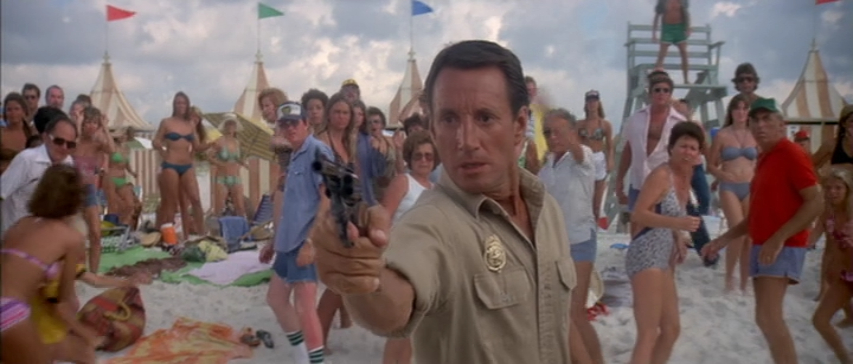
It’s here where I can guess at what the movie’s trying to do. Some of the most iconic bits in the original Jaws focused on Quint and his story about surviving the sinking of the USS Indianapolis. Quint’s backstory is wrapped in a whole lot of World War II survivor’s guilt (which I’ve written about before). In Jaws 2, the focus had shifted a bit and now we’re dealing with post-Vietnam War PTSD. While Chief Brody probably never served in Vietnam, this is definitely a film from the immediate post-Vietnam era3. Brody exhibits all the signs of post-traumatic stress disorder after his ordeal in the first film. Even the mention of a shark threatens to set him off, and he’s all too willing to brandish a gun in front of children at the thought of another shark attack.
The way the film depicts him, Martin Brody is most certainly Not Well. Roy Scheider’s reluctance to even appear in the film probably also has something to do with this. His disinterest in the role spills over into the character, presenting itself as a kind of manic depression. Whatever the case, the driving force in much of Jaws 2 is Brody’s deteriorating mental state. His hands are increasingly tied with regard to the killer shark on the loose, and it’s driving him crazy.
The moment he finally loses his job winds up actually setting him free. When his two kids, Mike (Mark Gruner) and Sean (Marc Gilpin), join Mike’s friends on a boating excursion to the local lighthouse, the shark attacks and renders their boats useless. The police even fly in a helicopter to help haul their boats back to shore, but guess what? Shark eats the helicopter. Yes, the shark takes down the helicopter, whose propellers further destroy more of the kids’ boats and now they’re at danger of drifting out to sea completely. Brody catches wind of this and steals the Amity Police boat to go save his kids.
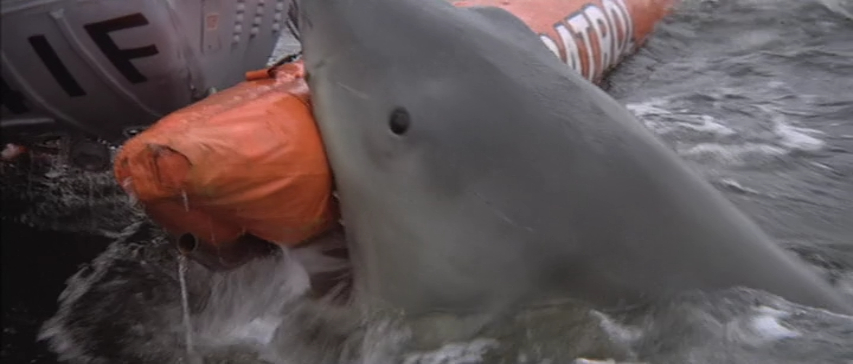
Where the first Jaws is a classic slasher first and an adventure film second, this one decides to abandon the adventure angle and go all in on the slasher bit. The entire third act of the film feels like the prototype for the classic 80s-style slasher. And by that, I mean it’s filled with obnoxious teens that you can’t wait to see get killed. Almost every last one of them sucks as characters, particularly Mike’s best friend Andy (Gary Springer), who checks off every box for obnoxious slasher fodder, but somehow makes it out unscathed.
If this movie has any legacy at all, it’s the fact that it essentially helped codify how the next decade of slasher movies would operate. Fill your movie with six to twelve teens (played by people in their mid-20s), make them every shade of annoying so we don’t feel too bad when they get hacked to pieces, and then just completely forget your own plot by the one-hour mark.
If it’s not obvious, I’m not a huge fan of Jaws 2. The movie just plain has too many things working against it, and it simply doesn’t have the juice to justify its own existence. At the risk of stating the obvious, there was simply no way it was ever going to top the original. Losing two of its main characters (three if you count the shark) already puts it at a disadvantage. Give me Quint and Hooper over a gaggle of annoying teens any day of the week. And for that matter, I find it hard to believe that this town council, having already gone through this ordeal once, wouldn’t give Brody a blank check to do whatever he wanted to get rid of another shark. Hell, I don’t understand why he isn’t the mayor already.
But if I can say anything for Jaws 2, I’ll say this: it is both the most competent and also the most boring Jaws sequel. Roy Scheider does his damnedest to keep this thing interesting, but it’s a Sisyphean struggle. He tries with all his might to rescue this film, but at the end of the day, what has he really accomplished? It was kind of a necessary evil to get to parts three and four, which are both more interesting, despite both being worse films. (For my money, Jaws 3-D is easily the worst. Say what you will about how ridiculous The Revenge might be, at least an attempt was made4.)
Moving forward, we’re going to see a number of films that take the Jaws formula for granted, as the initial boom of ripoffs came and went in the wake of Jaws 2. Maybe we should be grateful for that? Or maybe this is as good as it’s going to get…
FINAL RATING
2.5 stars (out of 5). It’s a perfectly okay film whose greatest sin is that it isn’t Jaws.
NEXT TIME: Devil Fish (1984)
- And later on the minor holiday classic Prancer. Dude had range.
↩︎ - The taglines for parts 3 and 4 are equally iconic. For Jaws 3-D it’s “The third dimension is terror!” (legally distinct from the tagline to Friday the 13th: Part 3’s “A new dimension in terror”.) And then, of course, there’s Jaws: The Revenge’s “This time it’s personal”, which underlines the goofiness of the entire premise, but also tweak’s the tagline from the previous year’s Aliens (“This time it’s war”).
↩︎ - A common joke surrounding Jaws 2 was that the French title for that film (Les Dents de la Mer Deux) sounded like “Les Dents de la Merde”, or “The Teeth of the Shit”, which is about as ‘Vietnam War’-coded as you can get.
↩︎ - I did an entire podcast examining Jaws: The Revenge here. ↩︎

Leave a comment