
Originally published August 15, 2015 on FrontRowCentral.com
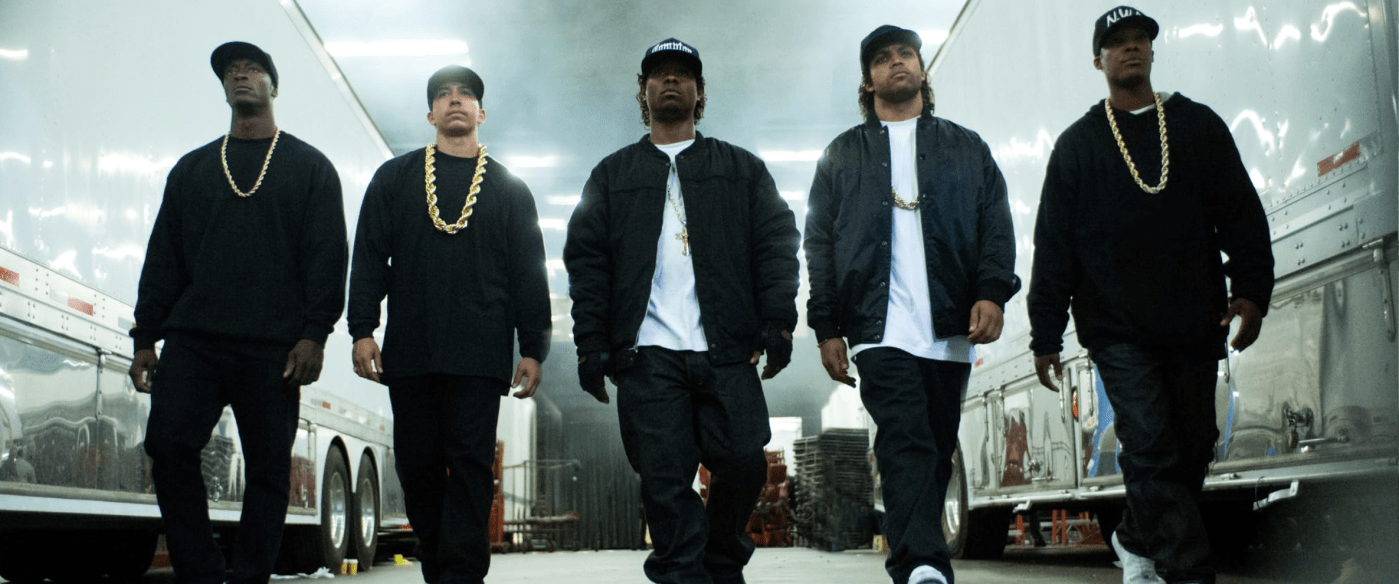
There are moments in Straight Outta Compton where N.W.A.’s music genuinely comes alive onscreen.
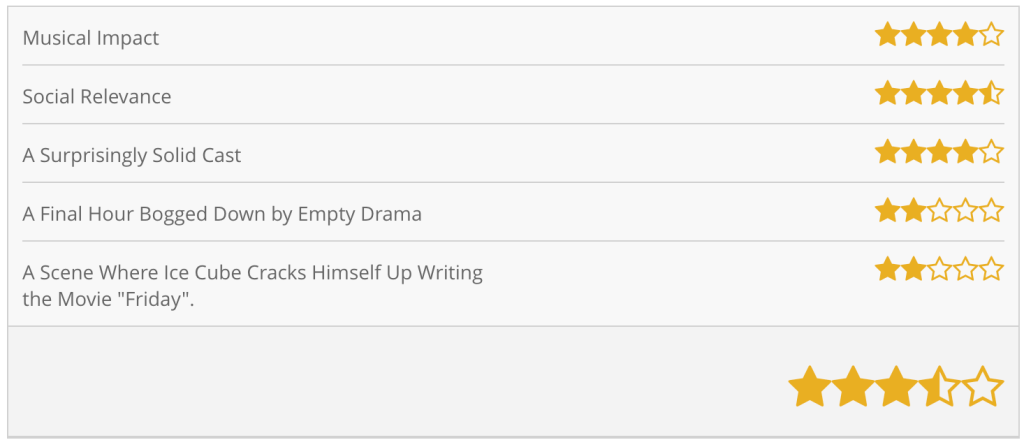
The portrait painted by Ice Cube, Eazy-E and the rest of their crew is still as vividly recognizable today as it was in 1989. In those moments, Compton flourishes in a way that many musical biopics (or any biopic, for that matter) simply can’t. It’s a well-mounted production, and the scenes in which the group’s music plays as an active force for change work beautifully. Sadly, these moments don’t come often enough, and they can’t overcome the rest of the film feeling like a trip down memory lane calculated by the very men who were there.
Broadly speaking, the film details the meteoric rise and equally quick collapse of LA’s seminal gangsta rap group. Realizing he can’t support a wife and child spinning records in a club, Dr. Dre (Corey Hawkins) comes to his friend Eazy-E (Jason Mitchell) with a proposal: Start their own record label and produce their own music. A rap group from New York comes out to record for them, but when they balk at the lyrics written Ice Cube (played by his son, O’Shea Jackson, Jr.), Eazy-E steps into the booth to record “Boyz-n-the-Hood” himself, and a star is born. E’s single quickly attracts the attention of producer Jerry Heller (a wonderfully scuzzy Paul Giamatti), who offers to manage E and his crew. This eventually leads to N.W.A. signing with Priority Records, cutting the film’s namesake album, and making history by raising a middle finger to every police officer in America.
Compton establishes the missions of its three subjects with amazing efficiency. Dre is introduced zoning out to his music, and when his mother chews him out for missing a big job interview, he takes his records and walks out, the epitome of cool. Ice Cube enters the film jotting down rhymes on the schoolbus when a group of Bloods climb aboard and yell at kids for throwing up gang signs. (Even the gangbangers tell kids to stay in school; it might be the best gag in the film.) This is the life Ice Cube is desperately trying to escape. E, on the other hand, is all about the money. The very first scene opens on him fleeing a crackhouse as the police barge in with a tank, making it clear that this is first and foremost his story. All of the events that transpire — the success, the wealth, the notoriety, the fallout — spiral out from the choices made by Eazy-E.
Of course, N.W.A. was more than just three men.
MC Ren (Aldis Hodge) and DJ Yella (Neil Brown, Jr.) round out the crew, but this film is laser-focused on its marquee trio. (An uncredited Brandon Lafourche briefly plays the group’s sixth member, Arabian Prince, but doesn’t even appear on the poster.) It would be nice if this were a more comprehensive look at the group’s rise to stardom, and the roles that every man played in its development, but Dr. Dre and Ice Cube pulling the strings behind the scenes puts a lid on that. They’ve chosen their cast well, though; doubly so in Cube’s case. It might sound like blatant nepotism to cast your own son to play you in your own biopic, but Jackson brings enough of his father’s energy to the role that it’s almost a no-brainer. He’s magnetic, and easily upstages everyone in the film whose name doesn’t end in Giamatti.
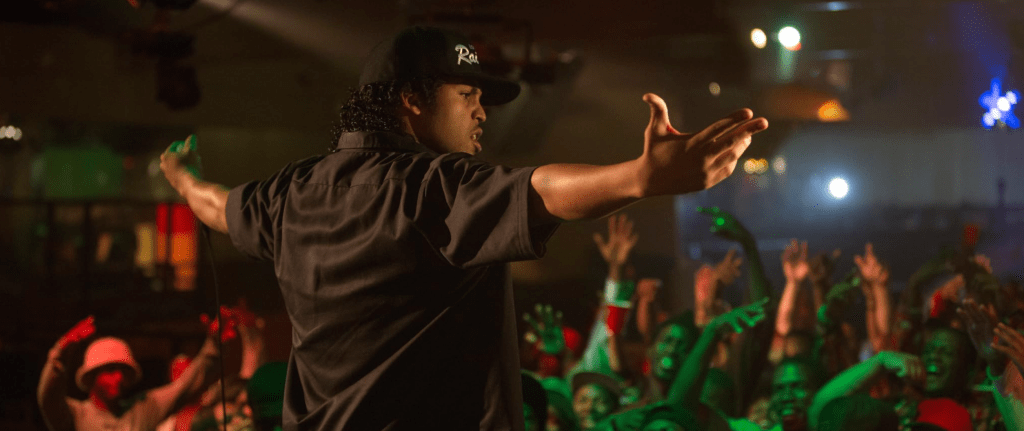
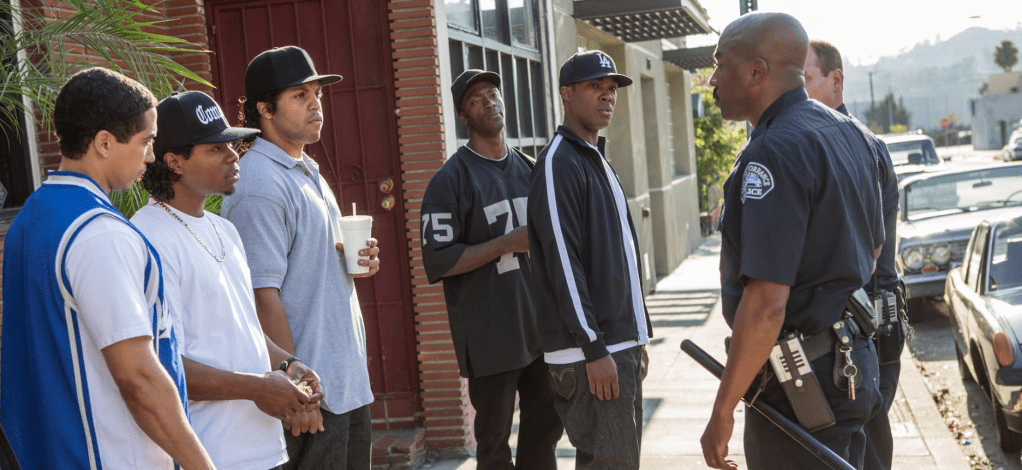
For an hour or so, this dynamic is electric. As soon as N.W.A. cut their first single, the crew find themselves running afoul of pretty much everybody, whether it’s the police, the FBI, or eventual enforcer/producer/comic book villain Suge Knight (R. Marcos Taylor). Every time a police car rolls by, the tension mounts just a little bit heavier. Cops show up in the film seemingly at random to harass the crew for no reason, almost coming across as a rival gang. One such incident outside their recording studio prompts Ice Cube to immediately write “Fuck tha Police,” and the heat they take from this song culminates in a riot at a concert in Detroit. It’s the film’s most sweepingly cinematic moment, and director F. Gary Gray stages it with amazing intensity. Unfortunately, it’s a high from which the film never manages to return.
From there, the second half of Compton seems to leap across events in the group’s history like a glorified episode of VH-1’s Behind The Music. Tragedy strikes, only for things to get worse. An opportunity arises, but is quickly squandered. Then, when the chips are down for Dr. Dre, a glimmer of hope emerges, only to be snatched away by a cruel twist of fate. And coming up after the break: Ice Cube writes his comedy masterpiece Friday on an early-90s laptop, while Dr. Dre plays a demo of “California Love” for up-and-coming rap artist Tupac Shakur. Much of the back end of the film plays out in a series of montages, featuring scenes like these. They’re by no means important to the narrative, and only serve to get a rise out of fans.
Ultimately, what makes this a compelling story in 2015 is that N.W.A.’s clash with the LAPD is tragically still relevant. This time last year, we cringed at Let’s Be Cops’ unfathomably bad timing right as the events surrounding Michael Brown’s death reached a fever pitch in Ferguson, MO. A year later, we’ve watched the same thing unfold time and again, with seemingly no progress made. For the back half of Straight Outta Compton to involve so much squabbling over contracts, royalties and master tapes feels like time wasted in a film that had already made its point perfectly well.

Leave a comment