
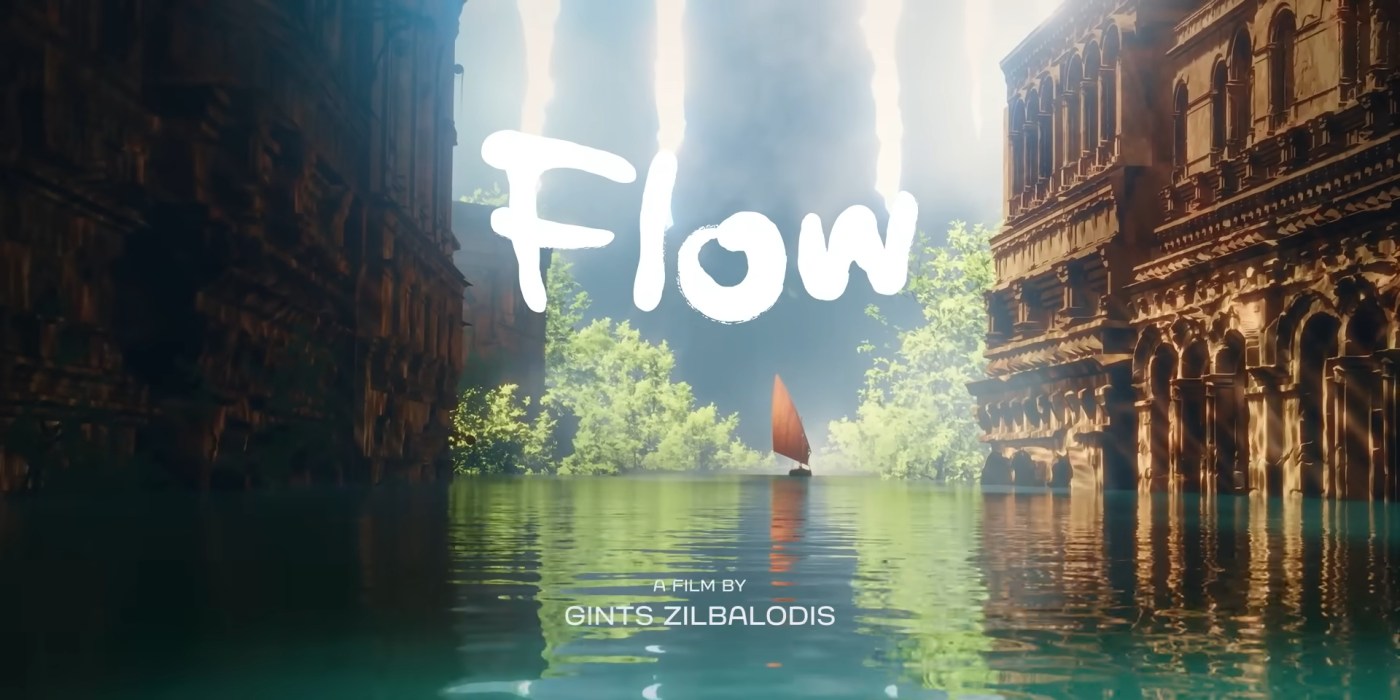
Remember in the Playstation 3 era you’d see all these little indie games pop up that were more style than substance? I’m talking Journey or Flower, or pretty much anything made by Team Ico. Video games that were more interested in presenting a unique vision of what art could do rather than trying to tell a compelling story. Flow feels an awful lot like that, like watching someone play one of those games and letting you just sit there and be mesmerized by the pretty colors.
Flow, briefly, is a beautiful piece of animation. If that were all there was to this film, I would recommend it without question or reservation. However, it is also slightly inscrutable, asking its audience to go along for what is sure to be a bumpy, stressful ride through a diluvial hellscape. That’s a lot of big two-dollar words to say that there’s not a whole lot to it, but also if you’re willing to sit and really connect with it… Maybe there actually is?
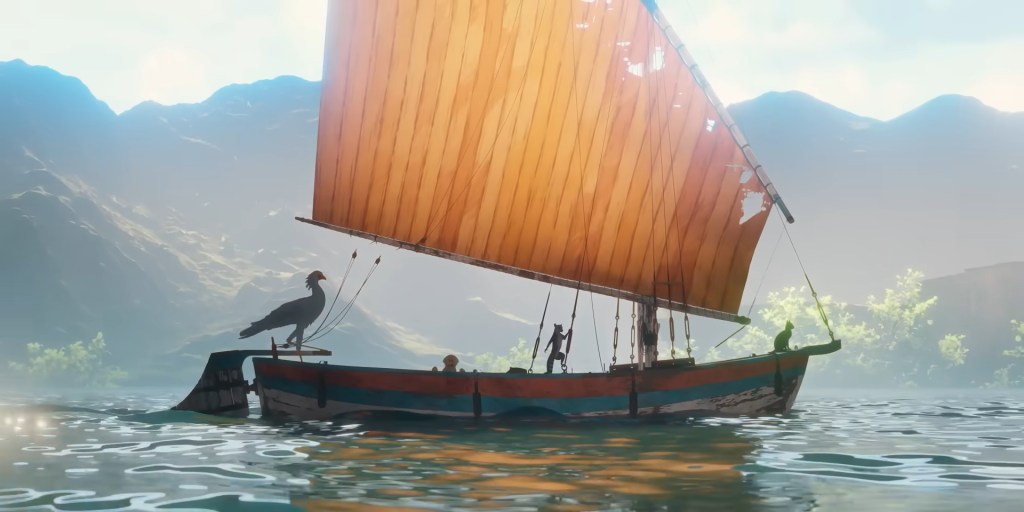
The movie tells a very simple story: Wild animals find themselves escaping a sudden flood by falling one by one into a derelict sailboat. There’s a capybara, a golden retriever, a lemur and towering over all of them is a secretary bird. And our protagonist, the one we follow through this disaster story, is a black cat. As the film opens, the cat finds itself outrunning a pack of wild dogs, only to encounter a herd of elk fleeing the deluge that set the whole thing in motion.
The lion’s share of the film follows the cat interacting with the other creatures, and the gimmick is that they’re all realistically-presented animals. No talking, no human features, none of that. Imagine if the story in Life of Pi was actually about a bunch of animals in a boat. They encounter obstacles that need overcoming (sometimes the boat gets stuck, sometimes other animals steal the lemur’s bauble collection), other animals who may or may not warrant rescuing, and may or may not also encounter God?
See, Flow is the kind of movie where one or two fantastical things happen, and it’s left to the viewer to determine what it all means. It’s entirely possible to ascribe a biblical reading of this story. There’s a cataclysmic flood, for starters. There’s a climactic scene where one creature ascends to the heavens, suggesting they may have passed a test, or been chosen for some greater purpose? It’s let intentionally vague.
There’s also the presence of whales. These whales periodically appear to either rescue our cast of critters, or at the very least keep an eye on them. There is a kinship established between these creatures, almost reverential. It reminds me most of the whale scene in Robert Zemeckis’ Cast Away. At one point Chuck Noland finds himself adrift on his raft in the middle of the ocean. In the middle of the night, he spots a pod of whales surfacing and meets one eye to eye.
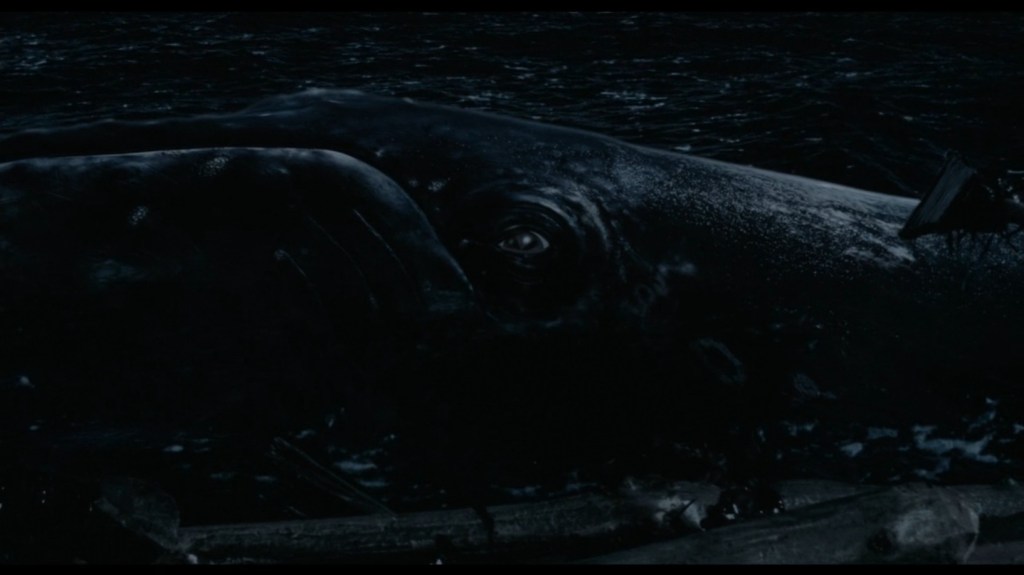
I’m not even a particularly religious person, but this has always read to me as God watching over Chuck and letting him know he has not been abandoned. It’s a quiet moment, one where Chuck’s journey takes him to the brink of creation (there’s a bit of Jonah and the Whale in there too, of course), but a deeply spiritual moment nonetheless. It’s kind of the same dynamic in Flow. At various points when the black cat’s journey seems to come to a dead end, a whale will inevitably make an appearance.
Then again, it’s entirely possible that a religious reading is entirely out of line. It could also simply be a story about nature restoring itself to balance in the wake of climate change. The early scenes certainly suggest it, as the cat leaps from point to point, fleeing the slowly rising tide until it climbs a gigantic cat statue towering above the landscape (another odd detail that has its own wild set of implications if you wanna go there) in a desperate search for salvation. But the water even eclipses that highest peak, suggesting that this is the ultimate calamity brought on by climate change.
It should also be noted that there are no human characters in this film at all. There were once human characters, presumably. There are houses and cities and giant cat statues that must have been built by someone. But the lack of any one human in the film goes further in suggesting some kind of terrible apocalyptic event. Only the animals are left behind, and while some band together to fend for themselves1, the majority realize that survival only comes when the whole kingdom works together.
And yet, while I do appreciate any film that lets me ascribe any of these meanings to it without settling on any one in particular, Flow becomes frustrating specifically because it never seems to want to settle. The journey is largely the point here, but the destination seems like a complete afterthought. Where does our creatures’ journey end? How and why? And where do we go from here? As far as the film is concerned, those questions matter so little that they’re hardly worth considering. To get back to the video game analogy from up top, Flow feels like watching a friend play one of those indie video games and then just randomly deciding when to stop. It’s a visual marvel, one worth seeking out I’d say. But this is one of those instances where leaving things open to interpretation finds the end result lacking.
- Lemurs, the most humanlike of all the creatures in this film, are bastards. ↩︎

Leave a comment