
Twenty 20-Sharks is a chronological survey of shark attack movies. In this entry we take a look at the film that brought shark attack movies back to the mainstream in a big, bad way: Renny Harlin’s 1999 shlock masterpiece: Deep Blue Sea.
So far in Twenty 20-Sharks, we’ve seen the shark attack movie evolve from a genre seeded in realism and a fascination with the deep, into something more trashy and exploitative in the wake of Jaws. Everyone wanted a piece of that pie, and we’ve seen how quickly the genre degenerated into mindless crime and espionage thrillers with sharks slapped on as window dressing.
But in 1999, all that changed with the release of Renny Harlin’s Deep Blue Sea. This is the first big swing in shark cinema since the Jaws franchise heyday. We’ve seen plenty of Italian knockoffs and indie also-rans up to this point (and plenty more to come), but this is the first time in a long time that Hollywood threw some real money at a shark movie. This time, though, the formula would have to change. Deep Blue Sea feels like a synthesis of two action-movie templates: The big ensemble cast disaster thriller (think stuff like The Poseidon Adventure), and the Die Hard-like siege thriller.1 Deep Blue Sea finds us rooting for a team of scientists and shark hunters as they try to escape an underwater research facility infested with hyper-intelligent sharks.
That’s… Hm. That’s honestly the whole movie in a nutshell. Deep Blue Sea is one of those “high concept” thrillers we love to mock of for being so simple, yet so elaborately dumb. But that’s also what’s fun about it.
The movie opens on a party boat in the middle of the ocean, where two young couples are doing what dumb teens in a slasher movie tend to do. One of them knocks an open bottle of red wine into the water which, because we already know what kind of movie this is, reads as blood in the water for a hungry shark. And because this is also kind of a slasher movie, the implication is clear: Young people drinking? And having sex? These characters are dead meat.
A giant shark inevitably attacks the boat, terrorizing everyone onboard, but is harpooned and wrangled to safety by professional shark hunter Carter Blake (Tom Jane!). This whole opening feels like the movie trying to communicate to us that it’s not going to be that kind of movie. Instead, Deep Blue Sea is going so much further over the top than anything we’ve seen so far.
We then cut to Los Angeles, where Dr. Susan McAlester (Saffron Burrows) has to answer to her corporate overlord (Ronny Cox) about one of their sharks escaping the Aquatica research facility in the previous scene. Her team is currently studying shark-brain proteins and their application as a possible cure for Alzheimer’s disease. Executive Russell Franklin (Samuel L. Jackson2) wants the project shut down, but gives them one more chance and joins McAlester at Aquatica to oversee the next round of testing.
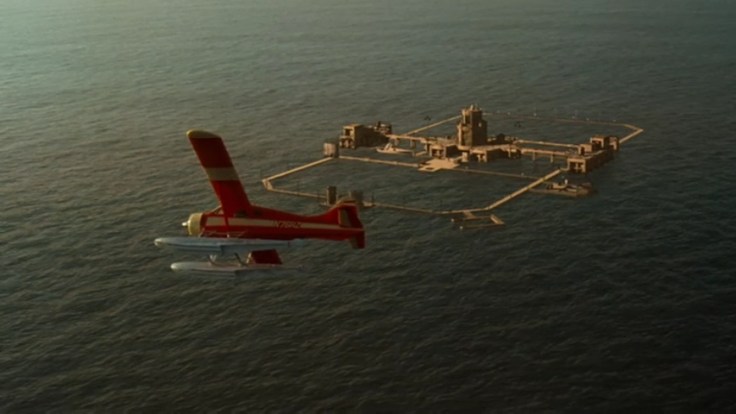
Aquatica is a big part of the movie’s whole high-concept charm. It’s a three-tiered facility out in the open ocean that makes the perfect setting for a hellish killer shark thriller. The surface features the lookout tower overlooking a fenced-in holding tank for three genetically modified mako sharks3. The second tier, underwater, houses the research lab and crew quarters, and the third tier at the bottom houses an underwater immersion pool and two-person submarine that we’re definitely gonna get to see in action. Kinda like in Die Hard, the movie takes great pains to show us the entire facility in the first act, because by act three we’re gonna have to traverse the entire goddamn thing. It’s also worth noting that the whole set was built in the same giant water tank that James Cameron had built for Titanic, and they make pretty good use of it here, gotta say. Lots of opportunities for flooded corridors and open water swimming.
The facility is run by a weekend skeleton crew, which I only mention because it’s genuinely hilarious to watch the boatload of drunken engineers sail away after a long workweek. You’d think that if Franklin hadn’t insisted on a weekend demonstration, all hands would’ve been on deck and none of what’s about to happen would have happened.
Blake has to sedate one of the sharks and haul it up to the research lab, where McAlester harvests some of its spinal fluid and squirts it directly onto a piece of Alzheimer’s-ridden brain tissue. The synapses start firing right away. Holy shit, they actually did it. They found the cure for Alzheimer’s! It’s… it’s in the brain stem of a mako shark that they’ve genetically modified to have a gigantic brain. What do you think giving a creature a bigger brain might do? You think it might make it smarter? More aggressive? Less willing to be an aquatic guinea pig? The answer is ‘all of the above’, as the shark wakes up and takes a big ol’ chomp out of Stellan Skarsgård!
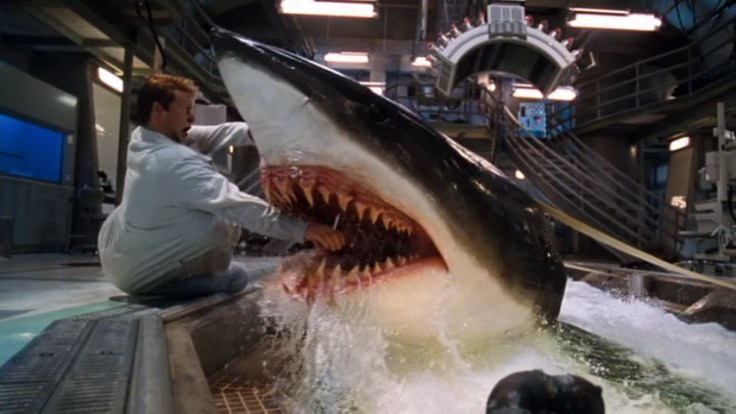
What happens next is a wild comedy of errors, and everything that can go wrong absolutely will, and in spectacular fashion. Skarsgård is airlifted out of the facility, but the helicopter’s airlift malfunctions, causing him to plummet into the water. Oh no, Stellan Skarsgård is dead! No, not yet… Because while the rest of the team scramble to figure out their next steps, one of the other sharks grabs the airlift with Stellan Skarsgård strapped to it and rams it into glass window of the research lab, killing him instantly and flooding the lab, releasing the other shark in the process4. Now our survivors—among them Blake, Franklin, McAlester, scientists Scoggs (Michael Rapaport) and Jan (Jacqueline McKenzie), and the onsite chef Preacher (LL Cool J)—are trapped like rats.
Preacher spends most of the movie alone, talking to his pet parrot while he cooks for the crew. When the shit finally hits the fan, it takes a looong time for Preacher to meet back up with the rest of the crew. This is probably because Preacher originally died a lot earlier in the script, but Renny Harlin enjoyed LL Cool J’s performance so much that he just kept writing extra scenes for him to shoot alone, eventually making him one of the film’s only two survivors. It would’ve been pretty shitty to kill a guy off only to have him rap over the end credits.
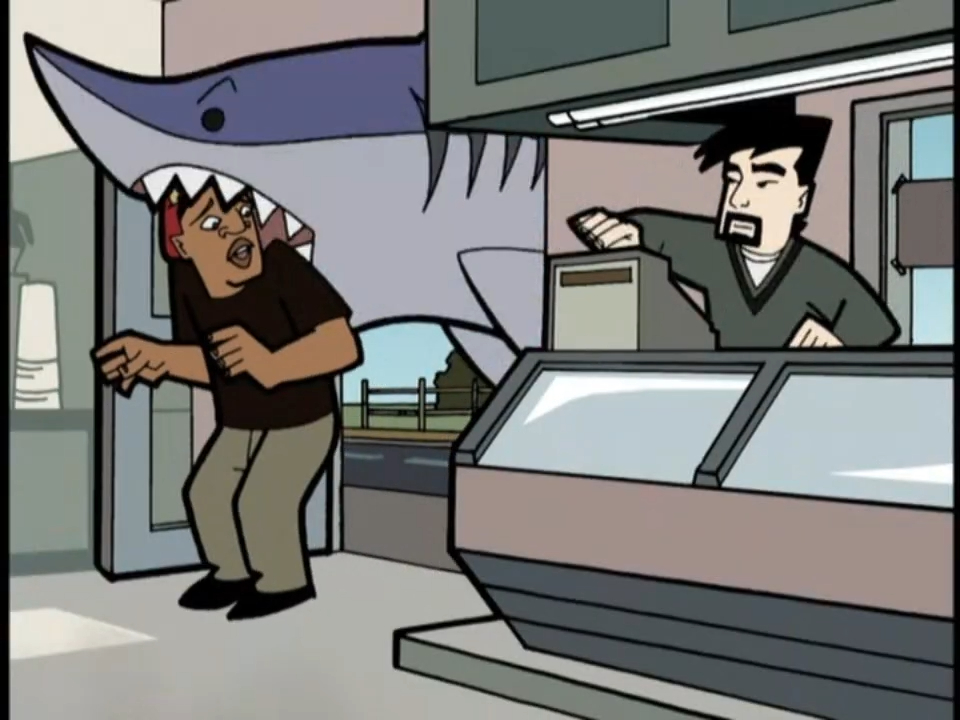
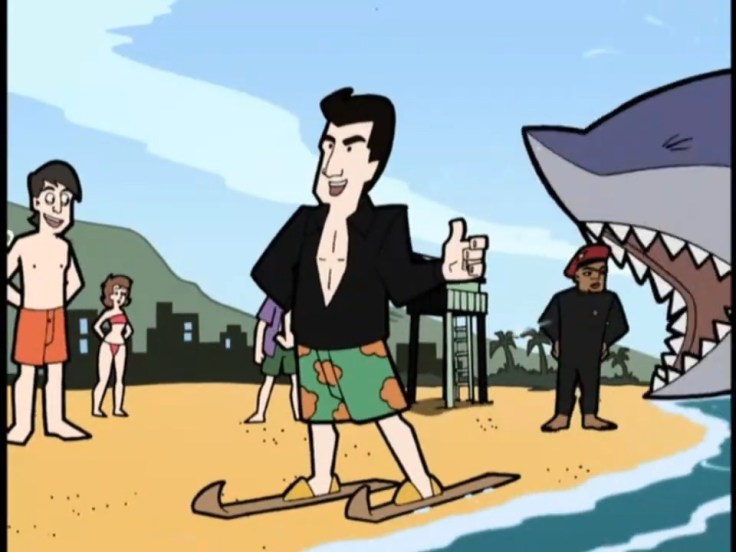
And speaking of killing off characters, the one thing this movie is known for above all else is the scene where Samuel L. Jackson delivers a rousing speech about teamwork and sacrifice, only to be unceremoniously chomped in half by a shark. It’s such a famously ridiculous death scene that the very next year, the short-lived Clerks animated series referenced it twice in the same episode.
If you really need me to explain how the movie ends, I’ll do that, but I’ll also suggest you watch more movies. They escape the facility and they blow up the sharks before they can break out into open water. More specifically, Blake and Preacher are two who make it out alive. It was originally going to be Blake and McAlester, but test audiences felt that the whole thing was McAlester’s fault and she should meet with a grisly fate, ultimately sacrificing herself to save the others. That seems kind of harsh, to be honest, and folks have been clamoring for years for Renny Harlin to release the original cut of the film with McAlester alive at the end. Maybe someday.
At the box office, Deep Blue Sea was a decent-sized hit, making $165 million on an $80 million budget. That was enough to make it the 22nd highest-grossing film of 1999, right behind Harold Ramis’ Analyze This and just ahead of the first Pokémon movie. It also did about twice as well as the summer’s other big killer animal movie, Lake Placid. Twenty years later, the series was revived for Deep Blue Sea 2, a film that, as far as I know, has absolutely nothing to do with the original. There’s also a Deep Blue Sea 3, and I very much doubt we’re going to get around to covering either one of them.
So the only thing left, then, is to assess whether any of this is any good. We could go by the Howard Hawks method, where Hawks once claimed a great movie has three good scenes and no bad ones. Judged solely on that merit, Deep Blue Sea has exactly two memorable scenes—Skarsgård and Jackson’s death scenes—but unfortunately no truly great ones. I can’t even call the movie bad, necessarily. Instead, most of it commits the cardinal sin of simply being boring. And when your movie is already about hyper-intelligent sharks loose in an underwater research lab, boring is just about the worst thing you can be.
There’s simply too much time spent with characters moving from one location to another and accomplishing nothing. The shark kills are outlandish and entertaining, Tom Jane and LL Cool J are great in it, but the whole promise that the movie thinks it’s making? Of going above and beyond what we think we want out of a killer shark movie? It never quite delivers on that promise outside of a couple of truly bonkers scenes. From here on out, shark attack movies will pivot and begin a game of oneupsmanship with against Deep Blue Sea. “How can we out-crazy Renny Harlin?” Some will succeed, but many will fail.
FINAL RATING
3 stars (out of five). S’okay.
NEXT TIME: A film that, in many ways, is the exact opposite of Deep Blue Sea. 2003’s Open Water.
- Though one could argue that Die Hard is more of a twist on The Towering Inferno, but I digress.
↩︎ - His second time working with Renny Harlin after The Long Kiss Goodnight.
↩︎ - The movie identifies them as makos, and then fudges it a bit by explaining that these are technically five times larger than regular makos.
↩︎ - Hey, at least they didn’t follow in Jaws 2 and Cruel Jaws‘s footsteps and have the shark eat the chopper. ↩︎

Leave a comment