
Twenty 20-Sharks is a chronological survey of shark attack movies. In this entry we discuss the early-aughts indie sensation Open Water.
Open Water came out in 2003, and was one of a handful of films that ushered in the era of digital filmmaking on a wider scale. Digital special effects had been around since the 80s, but had been largely gatekept by Hollywood studios due to their astronomical expense. But with the advent of digital video equipment, anyone could now pick up a camera and produce their own feature film. (Provided, of course, that they had a modicum of sense and knew how to tell a story. Even today, that part’s still non-negotiable.)
But I remember what a big deal this thing was when it first came out. Or at least, it was a big deal in the circles I ran in. Coming on the heels of things like The Blair Witch Project and Danny Boyle’s 28 Days Later, Open Water proved that the future of filmmaking was digital, and it was here to stay. It may have looked like shit, because early-aughts DV cameras did, in fact, look like shit. But it was here, nonetheless.
The film tells the story of Susan Watkins (Blanchard Ryan) and Daniel Kintner (Daniel Travis), a young couple who book an impromptu vacation to the Bahamas and decide to go scuba diving. And right away, I would be remiss if I didn’t mention the fact that the names Watkins and Kintner are a tribute to the first two people eaten by the shark in Jaws. They absolutely knew what they were doing with this.1
The first twenty minutes of the film give off the vibe of a young couple’s own home movies. The digital video lends the film that sort of homemade, shot-on-the-fly attitude. I wouldn’t go so far as to call it cinéma vérité, because even though the movie looks like something I could shoot with a Sony Handycam, the performances from the two leads are a little too tight and controlled for that. Blanchard Ryan came up through the MTV production pipeline, working her way up from effects crew to featured player. Daniel Travis had credits in a handful of TV series, and after this would go back to that grind almost exclusively. (Both had appeared in an episode of “Sex and the City”, oddly enough.) Outside of two or three featured actors, most of the people who appear in this film feel like locals they picked up when they arrived at the marina.
Susan and Daniel book a boating excursion, taking twenty people out into the titular open water for a half-hour scuba dive. There, the captain explains that, yes, there are sharks in the water, but they generally stay away from humans. No need to worry. Thanks to a series of machinations brought on by asshole diver Seth (Saul Stein), Susan and Daniel accidentally get left behind. This Seth guy, the moment we meet him, we just know he’s gonna be trouble. He’s the kinda guy you meet on every vacation who seems hellbent on ruining things for everyone.
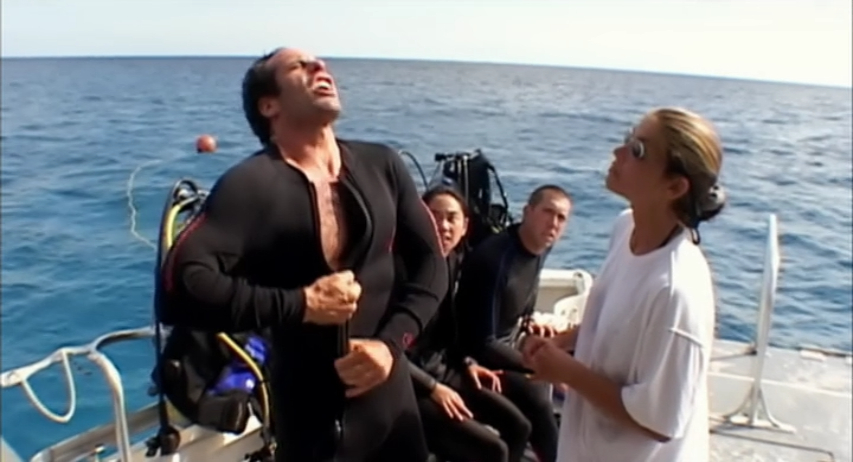
Seth forgot his diving mask. This guy, who professes to be an experienced, veteran diver, forgot his diving mask. They won’t let him in the water without one, so he borrows a mask from one of the other divers who comes back early. But now they won’t let him go in the water without a diving buddy, so one of the two divers who just got out of the water reluctantly agrees to jump back in. This causes the boat captain to miscount his guests and leave Susan and Daniel behind. Let’s ignore that their scuba tanks are unaccounted for, and their personal bags are still on the boat. But it’s an honest mistake. Probly happens all the time.
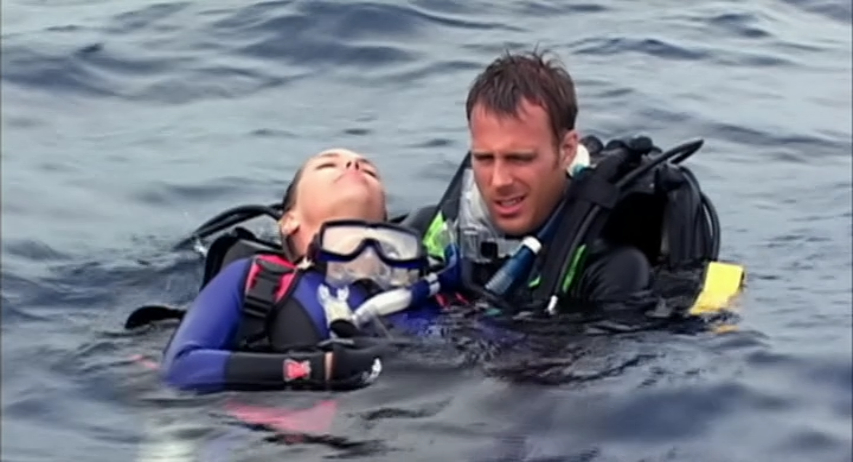
So now Susan and Daniel are adrift in the open ocean with no sign of their boat and no land in sight. The next hour of the film finds our couple struggling to survive, bickering amongst each other, and trying their best to fend off the creatures of the deep. At one point Daniel falls asleep and drifts away from Susan, forcing the pair to expend all their energy scrambling back to one another. Then they drift through a bloom of jellyfish, stinging the pair on their exposed skin. Next a barracuda nips at Susan’s leg, and now there’s blood in the water.2 Things consistently go from bad to worse until they’re now being circled by hungry sharks.
I guess at this point it’s worth discussing where the film came from. Open Water was written and directed by Chris Kentis. Kentis and his then-wife/producing partner, Laura Lau, were avid scuba divers themselves. Inspired by the real-life disappearance of divers Tom and Eileen Lonergan in 1998 off the coast of Australia, Kentis set out to tell pretty much that story and see how that might have played out. The couple financed the film themselves, reported to be roughly $130,000. Most of that money apparently went to hiring professional shark wranglers, because while this may be one of the vanguards for early-aughts digital filmmaking, the special effects in this film are very, very real. Those are real reef sharks swimming around with Susan and Daniel.
And as you might imagine, it took quite a while to shoot all of that. Two and a half years, to be exact. Filming on the open ocean has historically been a nightmare for film productions (See also: Jaws), so for a micro-budget affair like this, with only a handful of crew members likely pulling double/triple duty? Yeah, two years sounds about right.
But all that effort was worth it, in the end. Open Water may be light on the shark attack action, but the dread and anxiety of being trapped in the middle of the ocean is palpable. Watching Susan and Daniel bob up and down like corks with no way out is stressful, and every time a new sea creature arrives to make their lives a little bit worse? Yeah, it makes me squirm. It’s weird enough swimming with your toes in the sand, knowing that’s where crabs live.
Open Water is a breezy little 80-minute film, and I absolutely get why it became a sensation. The thrills are tangible and real, the filmmaking is about as direct and immediate as you’re gonna get, and the whole shot-on-DV aesthetic works in its favor. This thing looks like a home movie gone terribly wrong, and I appreciate that. Plenty of other filmmakers have experimented with digital video before and since, but I can’t say many have taken the limitations of the hardware and made it work for them the way Chris Kentis did.
The film made it into that year’s Sundance Film Festival, where it was immediately scooped up by Lionsgate Films and released nationwide in 2004. It opened 5th at the box office (#1 that week was Exorcist: The Beginning, directed by Renny “Deep Blue Sea“ Harlin). It ultimately made $55 million at the global box office, which is huge for a movie made for $130,000.
These days, it’s easier than it’s ever been for an amateur to make their own film. The cameras and editing equipment are loaded onto every smartphone on the planet. Every single one of us is our own indie movie studio. But the problem is that when anyone can make a film, it requires that much more skill and luck to ever get noticed. Films like Open Water still happen from time to time, but it’s exceedingly rare.
FINAL RATING:
4 stars (out of 5). S’pretty dang good.
NEXT TIME: The Reef (2010)

Leave a comment